

Greetings friends, I hope you are doing great! 🙂
Below is a fascinating guest article from Mr. Jun Honda, the designer behind the new Infineon GaN Class D amplifier, that I'd like to share with you.
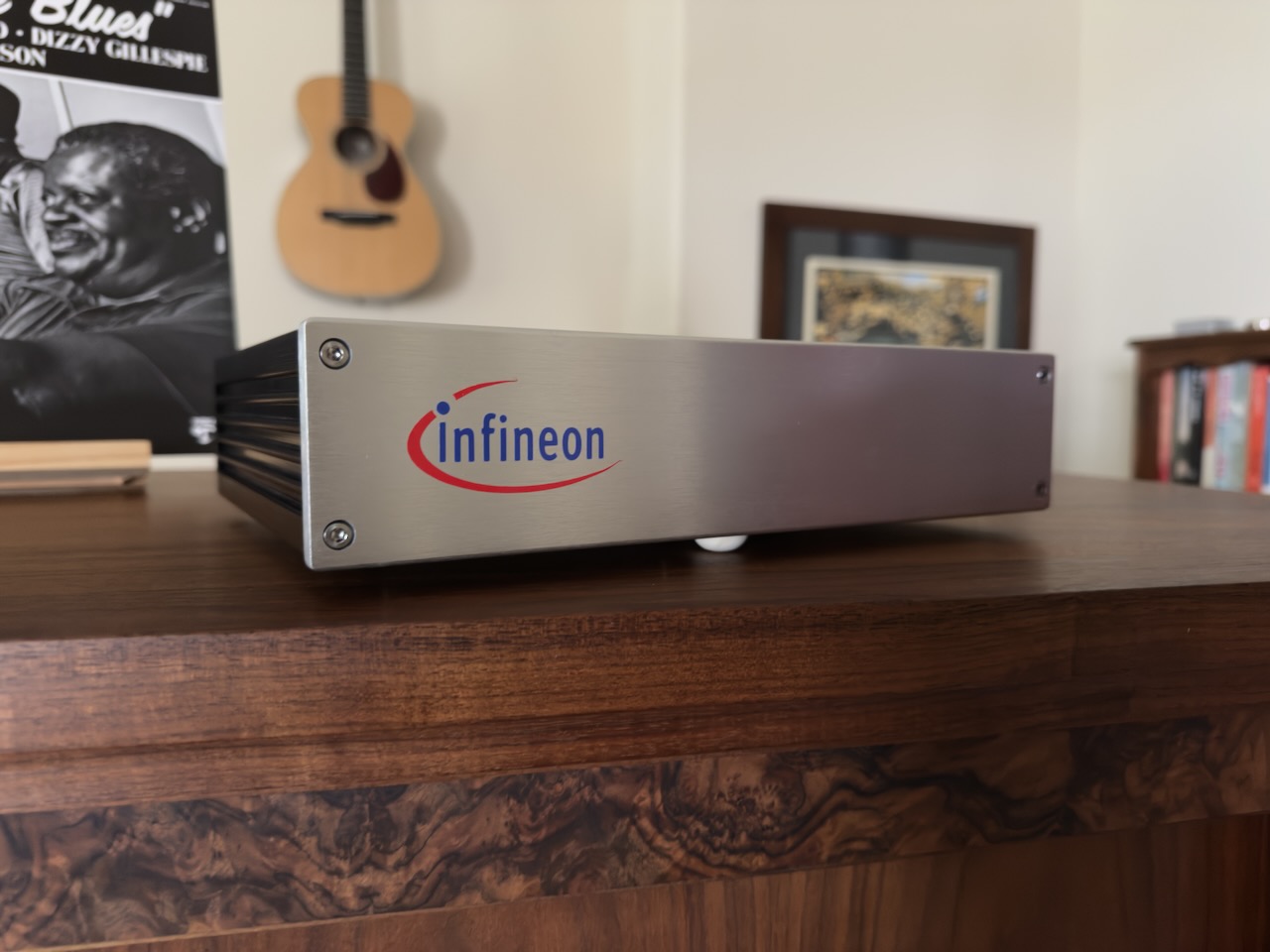
A big "Thank you!" to Jun-san for taking time to write this for us, and I think you will find it illuminating just as I did - enjoy!
温故知新 Onko-chishin: Gain new insights by studying the past! - Revering the Vintage Triode Amplifier.
It is touching to hear that you are comparing the latest GaN amplifier to SET amplifiers, as this is the exact direction my own journey is heading toward. I believe that the ultimate amplifying device is the direct-heated triode (DHT) in a single-ended (SET) configuration.
I have often wondered why triodes sound so good when their measurable audio performance doesn’t always appear as impressive as that of solid-state amplifiers. This led me to think that there must be forgotten techniques behind what makes SET amplifiers sound so great.
There is an old Japanese saying, Onko-chishin (温故知新) - which means developing new ideas by studying the past. This concept pointed me toward what I needed to do.

Above: Yazaki-san's DA30 SET monaural amplifier.
Ultimate SET amplifiers with hard-to-find, precious vintage components sound absolutely amazing. I wish more people had the fortune to own them.
My personal mission became extracting the design techniques behind classic tube amplifiers and realizing those concepts using today’s readily available components in solid-state amplifiers, so that more people can enjoy music with great sound quality. I see a glimmer of light in this GaN migration.
While Class A and Class AB designs will always hold a special place in audio for their proven musicality, it is exciting to see Class D—and GaN in particular—sounding remarkably like a SET amplifier, as Jeff-san noted.
I first noticed this similarity when I built my third Class D demonstration amplifier, the IRAUDAMP3, in 2005, and I have wondered why ever since.
Over the course of my development work with the Onko-chishin concept in mind, several theories have come to mind as to why a Class D design sounds so much like a SET amplifier. I would like to share a few of my thoughts on why this happens.
SET vs. Class D - Is a Class D amplifier a triode with 0 Ω plate resistance?
A triode operates as a voltage-in, voltage-out amplifying device, whereas traditional bipolar transistors and MOSFETs operate as voltage-in, current-out devices at the component level. By its very nature of operation, Class D amplifier also works as voltage-in, voltage-out topology. I realized that this is the first solid-state amplifier topology to operate in a voltage-in, voltage-out mode, just like a triode.
The main difference between a triode and a Class D amplifier is that a triode’s output has internal plate resistance (rp), which is a major source of distortion. When you eliminate the effect of rp, a triode voltage amplifier produces much lower distortion.
In comparison, a Class D amplifier has a much lower output impedance, typically in mΩ, which makes it fundamentally linear and robust against load current changes.
SET, Class AB vs Class D - No struggle with speaker back EMF.
Back EMF is the energy sent back to the amplifier when a loudspeaker converts mechanical kinetic energy back into electrical energy.
The way a power amplifier handles back EMF differs significantly between traditional amplification topologies and Class D designs.
Without any local or overall feedback in place, the natural output of a linear solid-state amplifier is a current source with a high output impedance, often in the 10’s of kΩ. Traditional linear designs solve this effectively by using negative feedback to lower output impedance.
In contrast, the output impedance of a Class D amplifier is nearly zero (in milli-ohms). Because of this, a Class D amplifier does not need the help of feedback to absorb back EMF from the speaker.
From an energy standpoint, a Class D amplifier offers bidirectional energy flow, just like a transformer with a dynamically changing turns ratio (its duty cycle). When energy is returned from the loudspeaker, the Class D stage passes it back to the power supply, unlike a linear topology, which dissipates that energy as heat.
The strongest reactive energy return occurs in complex, multi-way passive crossovers with large inductors and capacitors that store substantial energy.
This means a Class D amplifier operates efficiently without struggling against phase shifts when driving a powerful woofer with a large magnet, or a multi-way speaker with LC resonance in its crossovers.
SET, Class D vs Class AB - No gain modulation from speaker current.
Another significant difference between traditional linear solid-state amplifiers and Class D designs is gain modulation caused by output current flowing to the loudspeaker.
The gain of a bipolar transistor, transconductance, is proportional to the load current, which naturally generates distortion. To maintain a constant gain regardless of speaker current, a bipolar transistor relies on heavy feedback correction. Fortunately, the open-loop gain of bipolar transistors is high enough to achieve sub-0.01% distortion.
On the other hand, a Class D amplifier has no gain modulation from load current. That behaves just like the amplification factor (µ) of a triode, which remains independent of output current.
Class AB vs SET, Class D - No temperature drift in bias current.
In a SET amplifier, bias current has very low sensitivity to ambient temperature. Silicon transistors exhibit a strong temperature dependency: heat increases both gain and current to the point where thermal compensation is required to prevent thermal runaway. While these compensation circuits work well for long-term stability, instantaneous bursts of output power heat the transistor junction and shift its operating bias point, altering gain at the device level.
A Class D amplifier operates its semiconductor devices only in fully ON or fully OFF states, eliminating the concept of active bias point altogether. As far as the power stage goes, it performs consistently across all four seasons without suffering from dynamic thermal bias modulation.
Class D vs Class AB - No crossover distortion at zero-crossing.
Just like SET amplifiers, Class D amplifiers have no zero-crossing crossover distortion.
In a Class AB amplifier, one of the two output transistors drives the loudspeaker depending on the direction of the output current. As the signal crosses over between the two output devices, a kink in linearity occurs, which is known as crossover distortion. This distortion occurs whenever the output current alternates, which happens continuously during music playback. A Class A amplifier keeps its output device conducting all the time, eliminating this issue.
The output power devices of a Class D amplifier also operate continuously. However, a Class D amplifier still exhibits a crossover-like distortion. Rather than occurring at the zero-current point, this gain transition happens at a specific threshold of output current. In the 1MHz demo amplifier, this occurs at around 3 W in 8 Ω, 6 W in 16 Ω. Avoiding a gain transition during sensitive, low-level signals is a major sonic advantage. During typical music playback, I estimate that a Class D amplifier operates in this non-gain-crossing operation region most of the time.
SET, Class AB vs Class D - The AC bias effect of high-frequency “leakage” in a class D amplifier.
There are ongoing discussions regarding non-linearity and hysteresis occurring in electrical components and contacts whenever current alternates. It is my hypothesis that a small 1 MHz carrier leak from a Class D amplifier may act like an AC bias, helping to reduce these zero-crossing non-linearities similar to how AC bias works in magnetic tape recording. If this effect holds true, a higher frequency carrier could provide even better linearization, which explains another reason why 1 MHz PWM sounds much better than typical 400 kHz switching.
In a SET amplifier operating in Class A, the audio signal is superimposed onto a DC bias, meaning a constant DC current flows through the output transformer. While this was unavoidable back then, it naturally bypasses zero-crossing challenges. A Class D amplifier solves this zero-crossing issue without sacrificing efficiency, which I find remarkable.
SET, Class AB vs Class D - Power Supply Scaling: How Small Class D Designs Control Tough Loads.
The strong loudspeaker drivability of Class D amplifiers stems partly from how it handles back EMF, as mentioned above.
Another major factor is how it interacts with its power supply. The similarity lays in comparing the impedance transformation ratio of a SET amplifier’s output transformer to the duty cycle power conversion ratio of a Class D amplifier. Both a SET amplifier and a Class D design draw power supply current that is much lower than the speaker output current.
A tube amplifier increases its effective bus capacitance -as seen from the output, by using an output transformer to convert the ratio between voltage and current. A 300B SET amplifier with a 3 kΩ : 8 Ω output transformer has a capacitance scaling ratio of 375x, which makes a 47 µF +B capacitor 375 times higher at 17,625 µF from the perspective of the amplifier output. This provides a tremendous amount of energy to drive a loudspeaker down to very low frequencies.
A Class D amplifier achieves a similar effect, except the conversion ratio changes dynamically with output power: the lower the output power, the higher the conversion ratio. At 10% of rated power—say, 10 W from a 100 W Class D amplifier—the conversion ratio is 10x, making a typical 4,700 µF bus capacitor appear as 47,000 µF looking back from the output. Drop down to 1% of rated power (1 W), and the conversion ratio reaches 100x, scaling that same capacitor to an impressive 470,000 µF.
This suggests that pairing an oversized, high power Class D amplifier with a highly efficient loudspeaker provides extraordinary energy reserve.
From a frequency response perspective, this conversion ratio reduces low-frequency droop in the power supply voltage, allowing a smaller capacitor to work effectively. Sonically, very large electrolytic capacitors often tend to lose speed and punch as they enrich low-frequency weight. In other words, choosing supply capacitance usually involves a tradeoff between bass quantity and bass definition.
Because a SET amplifier offers a high scaling factor, it can use a smaller capacitor that delivers both low frequency energy and tight definition simultaneously. Similarly, a Class D amplifier scales the capacitance toward the speaker load, delivering rich authoritative bass while preserving speed.
SET, Class AB vs Class D - Class D amplifier dreams: the promise of infinite improvement backed by large-scale investments.
The operating principle of a Class D amplifier is theoretically ideal, offering 100 % energy efficiency while delivering 0 % distortion. What determines real-world performance is output switching accuracy. Because Class D operation is fundamentally linear in principle, it takes a different path from traditional linear topologies, that rely on clever circuit and feedback designs to linearize non-linear transfer functions.
Mature bipolar transistor technology has already been refined to high-level, leaving less room for dramatic improvement in device linearity or power efficiency. In contrast, next-generation power semiconductors directly improve switching behavior, yielding both better efficiency and superior audio performance. Class D amplifiers improve along with them.
Because power semiconductors form the backbone of global digitalization and automation, they benefit from massive, large-scale investments. It is fortunate that a core audio technology overlaps with such a big industry movement, allowing the audio amplifier to evolve together.
This reminds me of triodes’ evolution into the legendary Western Electric 300B and WE 91A SET amplifier through massive commercial investment for talkie cinema in the 1930s.
A huge "Thank you!" to Jun-san for explaining the benefits to us of Class D operation in comparison to SET & Class AB vacuum tube amplifiers.
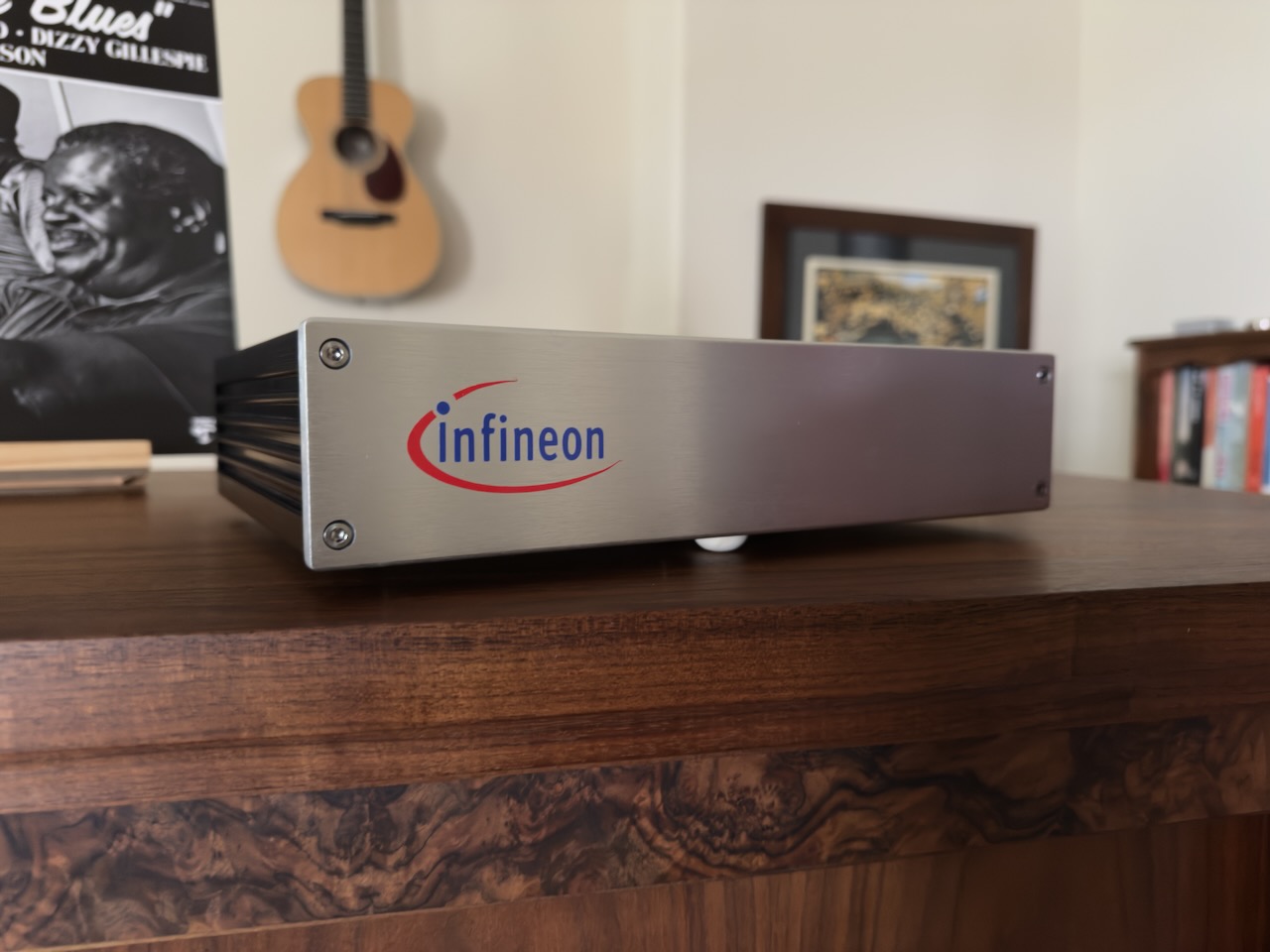
I'll be comparing Jun-san's Infineon GaN Class D amplifier to a variety of vacuum tube and solid-state amplifiers in the near future.
I'll start by comparing the GaN Class D amplifier with the First Watt SIT-3 static induction transistor amplifier, which I consider to be a milestone in triode-like solid-state amplifier design, and my reference for what is possible in performance on the solid-state front.
As always, thanks for stopping by, and may the tone be with you!
Previous articles in this series about the Infineon GaN Class D amplifier:
First Impressions: Jun-san's Infineon GaN amplifier! Is this the end of a 100-year era in audio amplifiers, and the beginning of a new one? HERE
"World Premiere" of the Infineon GaN Class D amplifier technology! A new "SET" for the 21st Century? HERE
Exciting news: "... a landmark development in the century-long history of amplifiers." HERE