



Greetings friends, I hope you are well! 🙂
I hope you've had a chance to read my article about the unveiling of the very latest Infineon GaN Class D amplifier technology at “OTOTEN 2026” in Tokyo HERE.
The Infineon GaN Class D amplifier made a huge positive impression on attendees at the “OTOTEN 2026” HiFi festival in Tokyo, one of which was friend Yazaki-san, who many of you know from his articles here at Jeff's Place, his involvement in developing an "SET-like" sounding Class D technology for the Spec Corporation amplifiers, and of course his own custom hand-crafted SET amplifier designs he builds for a few select HiFi aficionados around the world.
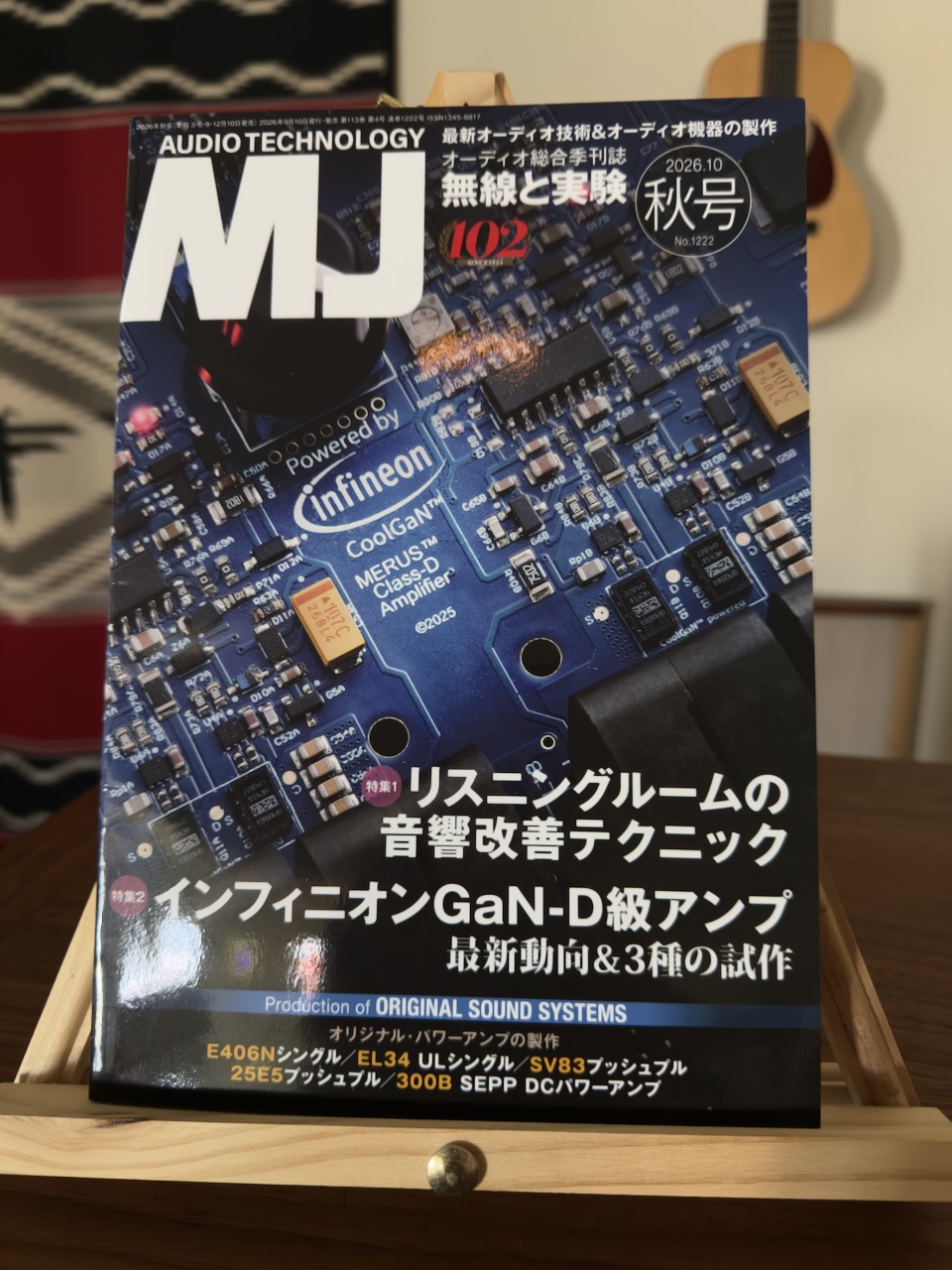
Photo above: The latest issue of the MJ Audio Technology magazine from Japan.
The reception for the Infineon GaN Class D amplifier was so positive that the prestigious MJ Audio Technology journal that was established 102 years ago, in 1924, featured it on the cover of their October 2026 issue, and had extensive coverage of it in four separate "deep dive" articles. That's rather unprecedented coverage for the unveiling of a new amplification technology!
I received this message from Yazaki-san:
"During the recent "OTOTEN" event in Tokyo, Jun-san [Mr. Jun Honda of Infineon - Jeff] mentioned to me that there were no plans to hold a launch like this anywhere outside of Japan. That is why I decided to ask you—given the global influence of Jeff’s Place—to unveil this "GaN Class D system," a system that holds truly immense potential. ... Through this project, I only hope that you will not only experience the potential of GaN technology, but also gain insight into the musical philosophy that Jun-san has cultivated over many years—indeed, throughout his entire life ... I am genuinely excited to see how things will unfold from here."
All I could say was, "WOW! And YES!"
Yazaki-san replied, "Jeff-san, thank you so much for taking on the vital role of hosting this "World Premiere."
I am of course delighted to host the "World Premiere" of Jun-san's Infineon GaN Class D amplifier, and am humbled by such a momentous request.
It's exciting to be taking part in a historic amplifier event by telling you about this, and as Yazaki-san has said to me:
"I believe Infineon's GaN Class D technology will likely be regarded by future generations as a landmark development in the century-long history of amplifiers."
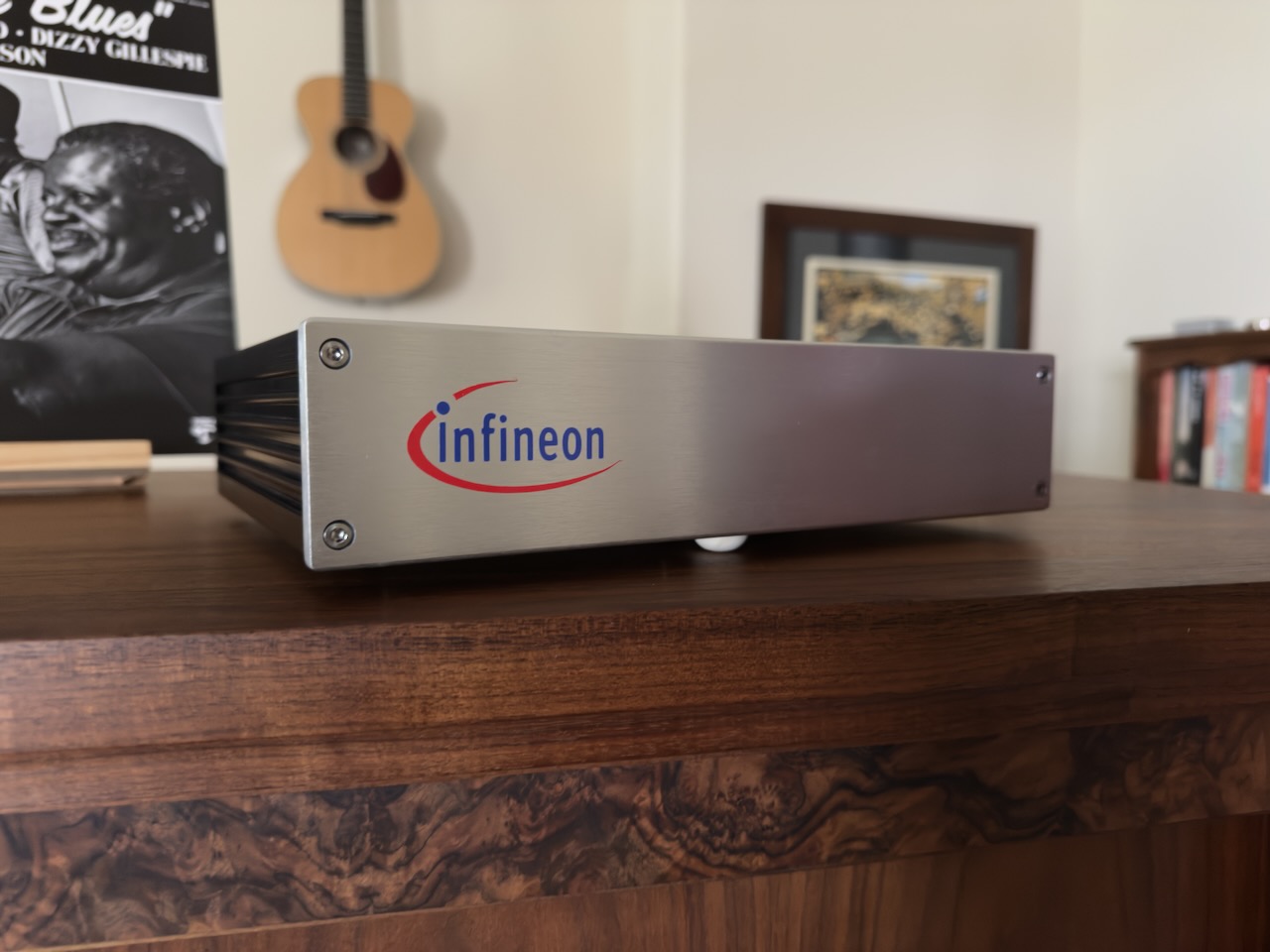
Today the Big Brown Truck dropped off the very latest version of the Infineon GaN Class D amplifier.
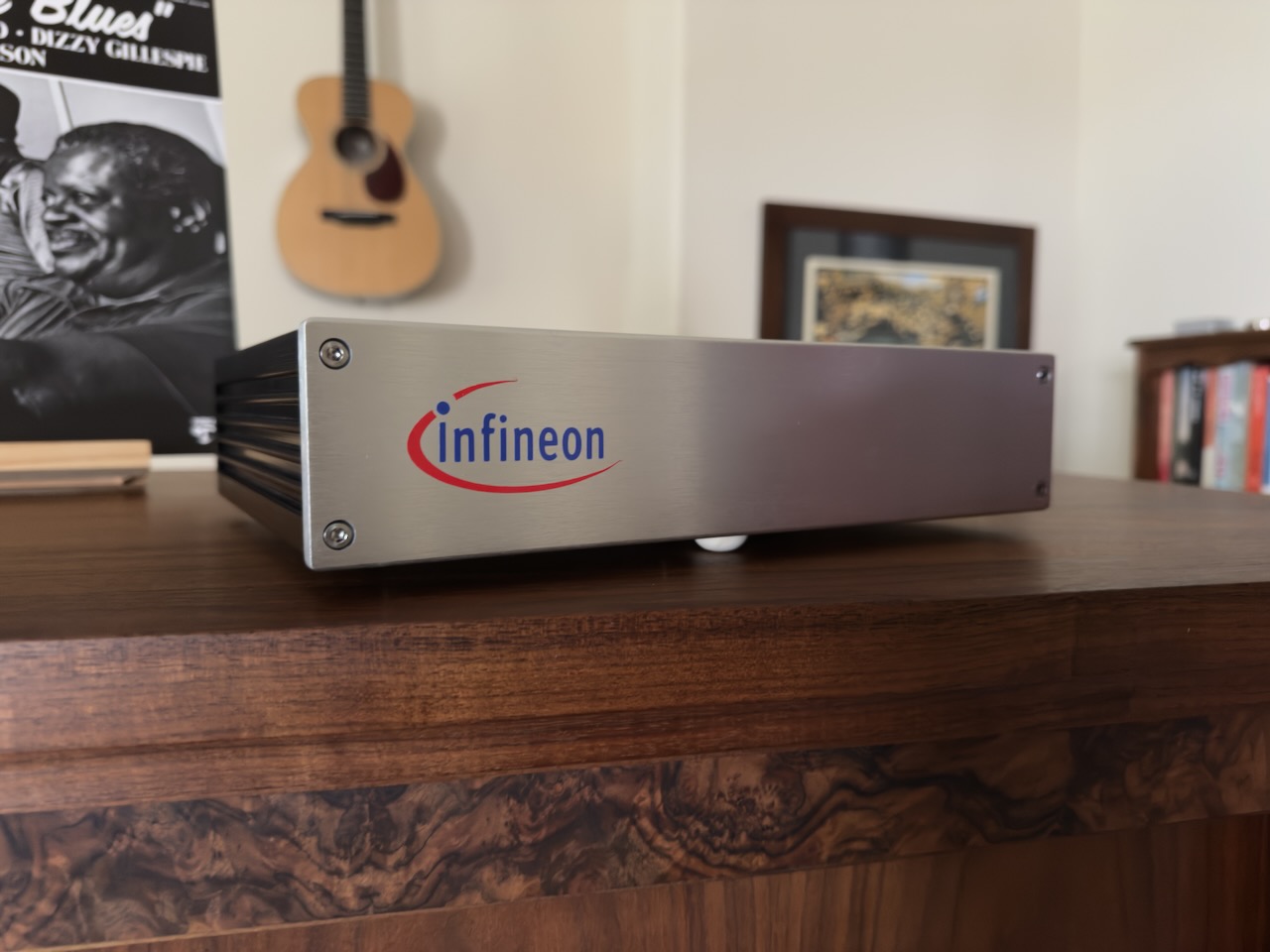
Photo above: Infineon's newest GaN Class D amplifier.
I asked Jun-san if he could tell us a little more about this new GaN Class D amplifier:
"This is the first demo amplifier featuring Infineon's 175V GaN device. The demo amplifier used at OTOTEN is a different unit though using the same reference design board. These were built by the magazine writers and the distributor FAE who is a DIY audiophile. All based on the same board. In fact, one of the demo amplifiers at OTOTEN was a prototype from the high-end amplifier brand, DVAS."
"As you might know, Infineon makes semiconductor chips. My role is to promote the latest power devices in audio applications. I am hoping that there are some premium amplifier products that hit the market soon."
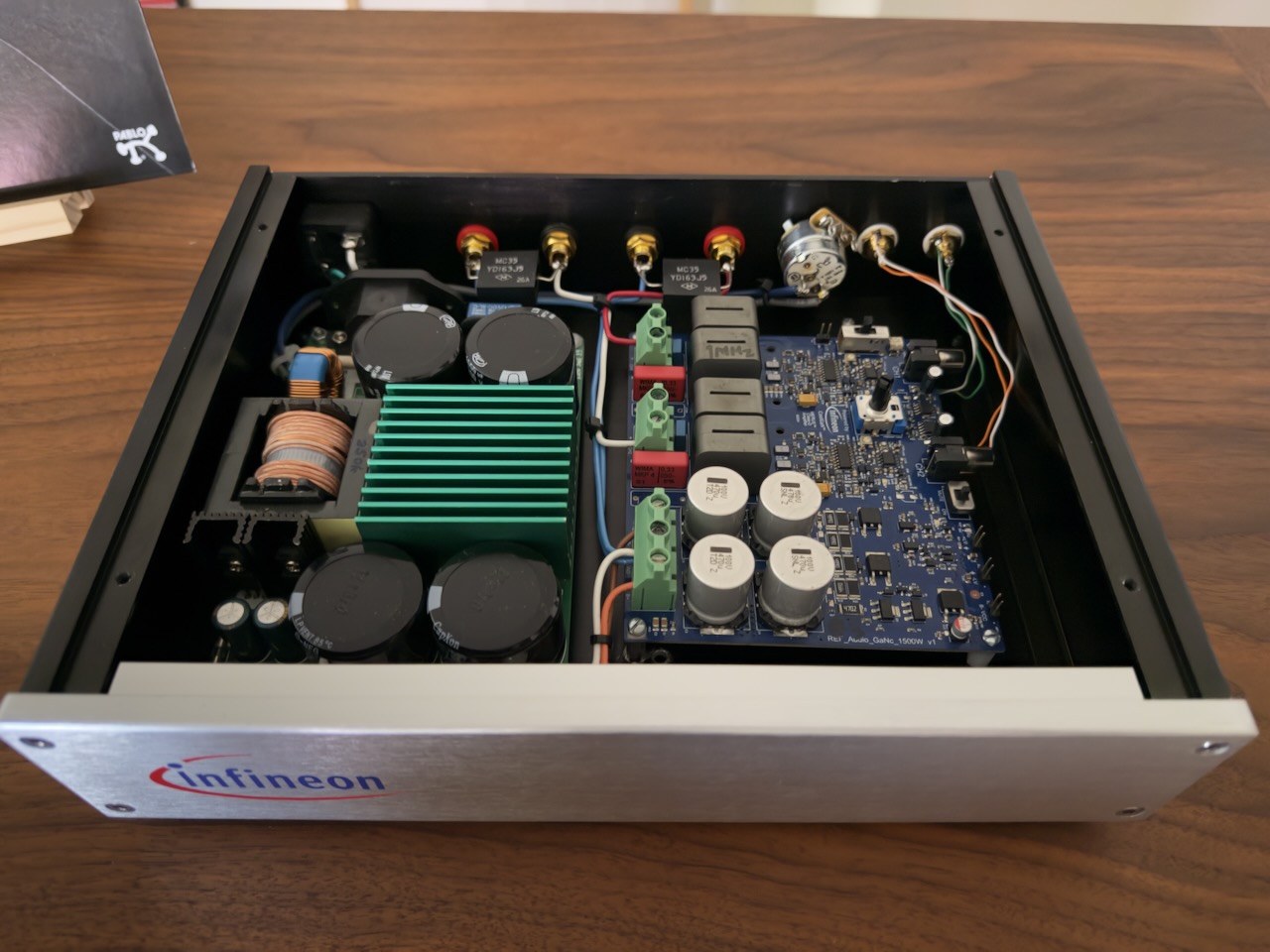
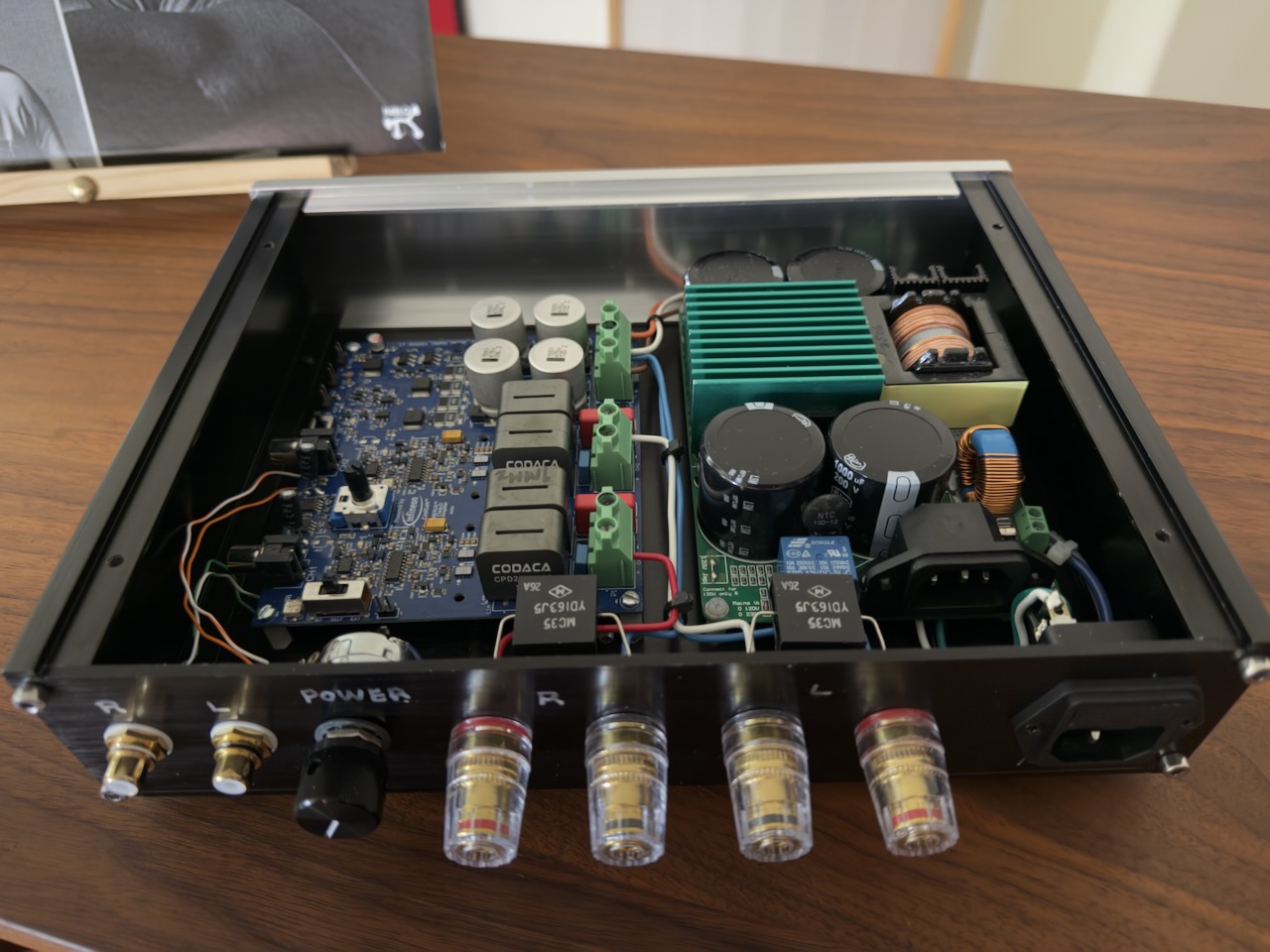
Photo above: Inside the Infineon GaN Class D amplifier.
"The amplifier shipped is my hand-made amplifier which uses the GaN Class D board along with a DIY switched mode power supply to demonstrate the power density. If a reader would like to try building the same amplifier, they can."
"I feel that one of the key aspects of this amplifier is that it serves as a base design that is available for anybody who wants to try. From there, they can modify it with special components such as Yazaki-san's Ultimate Ruby Mica and Cactus oil capacitors."
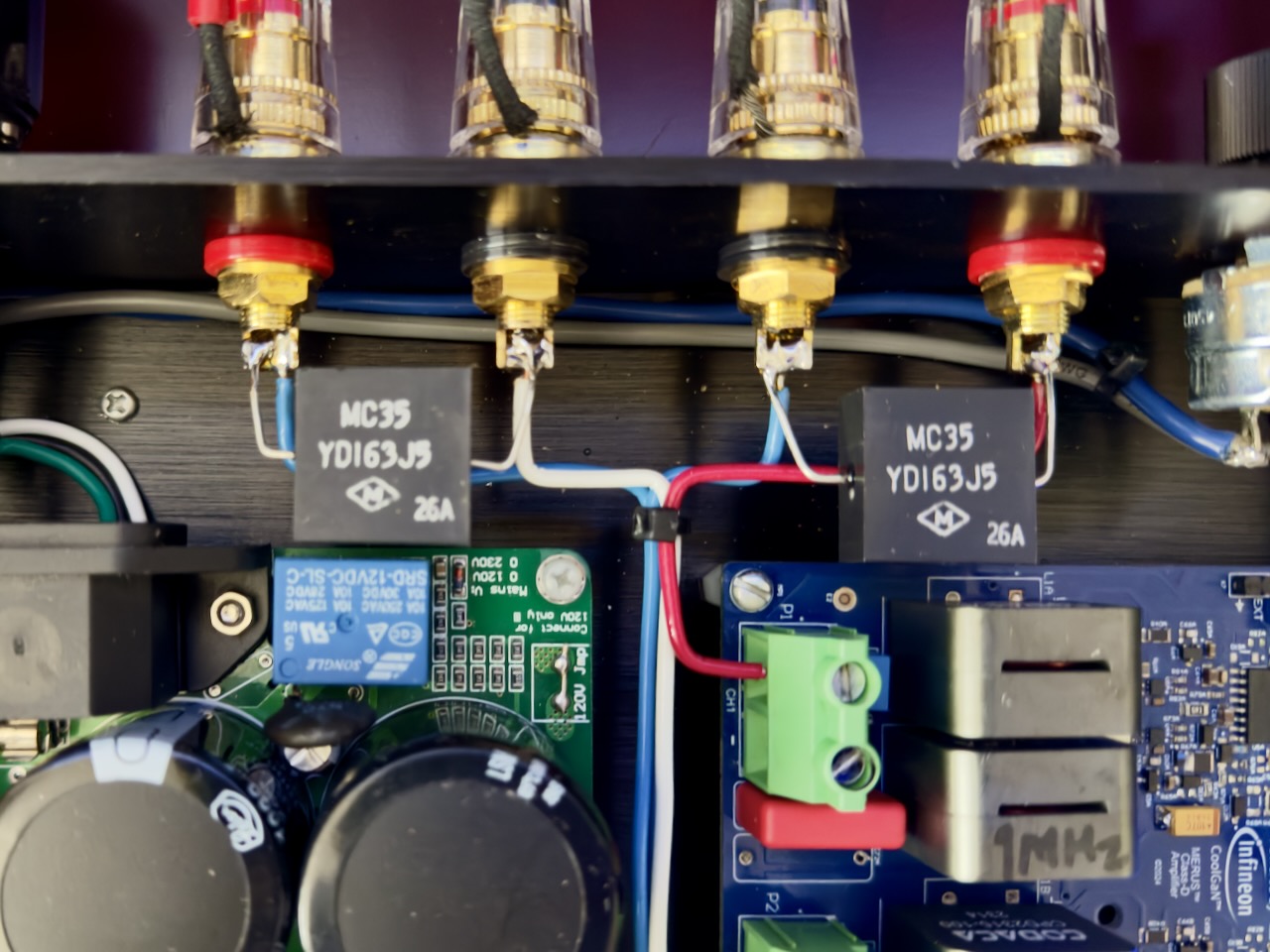
Photo Above: Note Yazaki-san's Ultimate Ruby Mica capacitors across the binding posts.
"With this concept in mind, the amplifier is built using readily available generic components. However, this time I could not resist adding the Ultimate Ruby Mica capacitor to help shape the sound quality."
"This is the latest GaN device from Infineon, launched this year. There are many GaN amplifier products already on the market using various vendor devices including International Rectifier and GaN Systems - both of which were acquired by Infineon."
Above photo: Rear view of the Infineon GaN Class D amplifier.
"What unique about this amplifier includes following:"
"- It features the latest 175V CoolGaN device that operates at 1 MHz, 2.5 times faster than a typical Silicon MOSFET class D amplifier. This design offers very small size and (probably) highest output power achieved without using a heatsink."
"- It carries the legacy of IR's PowIRAudio class D amplifier topology, design philosophy and tonal character."
"- It uses self-oscillating PWM with the IRS20957 controller IC that we have been using since 2007, allowing easy migration from Si MOSFET to GaN HEMT. It greatly simplifies the design compared to discrete solutions."
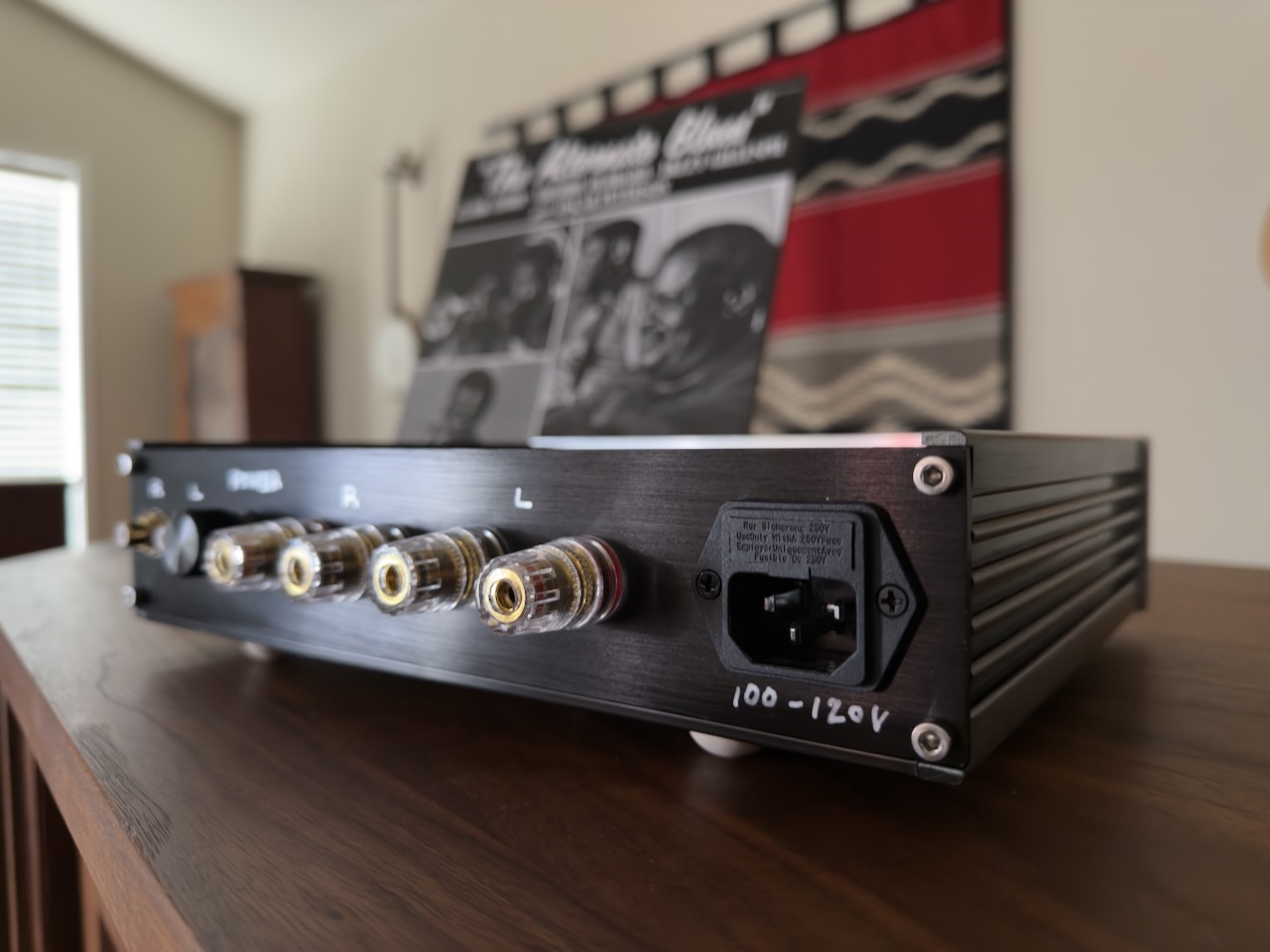
Above photo: Rear view of the demo Infineon GaN Class D amplifier.
"Making the power stage area as small as possible is key in Class D amplifier design, especially with higher switching frequency. The IRS20957 helps realizing the requirements."
"As you know from Yazaki-san's story, I started class D amplifier application at International Rectifier (IR) in 2003. I have been designing dedicated MOSFETs, controller ICs and module products ever since. "
"I have been involved in GaN device development since 2008, when IR successfully made a practical GaN device first time. I have attached a picture of my first (and probably world's first) GaN-based class D amplifier with a bare GaN chip on the board taken in 2009."
"As far as I know, IR succeeded with the first commercial consumer mass-market product in a Samsung GaN home theater in 2013, which I helped provide the solution for."
"Back then, GaN was a normally-on device, which is different from today's normally-off GaN devices. GaN devices went through a couple of major evolutions that brought the device to commercial success in recent years."
"In 2018, Infineon developed the normally-off CoolGaN series of GaN devices. I designed the EVAL_AUDAMP24 using the 400V CoolGaN device, and that design was launched in 2020. This design triggered a couple of premium audio amplifier products. In 2023, the first GaN based car amplifier was launched using this design."
"The latest generation 3 GaN arrived in 2025. The amplifier I sent uses this device. While we are waiting for amplifier products from high-end brands, this amplifier serves as a sneak peek of what the latest technology can offer in audio amplification."
"The output power is about 200 W clipping into 8 ohms per channel. Using 16 ohms would make it half of that as the power is limited by the power supply voltage."
Photo above: Inside the Infineon CoolGaN™ demo amplifier.
"This is the first demo amplifier built featuring Infineon's 175 V CoolGaN™ transistor. The unit features the same board, REF_Audio_GaNc_1200W, showcased at the OTOTEN in Japan in June 2026. This demonstration highlights the exceptional power density made possible by the superior physical performance of the Gallium Nitride High Electron Mobility Transistor (HEMT)."
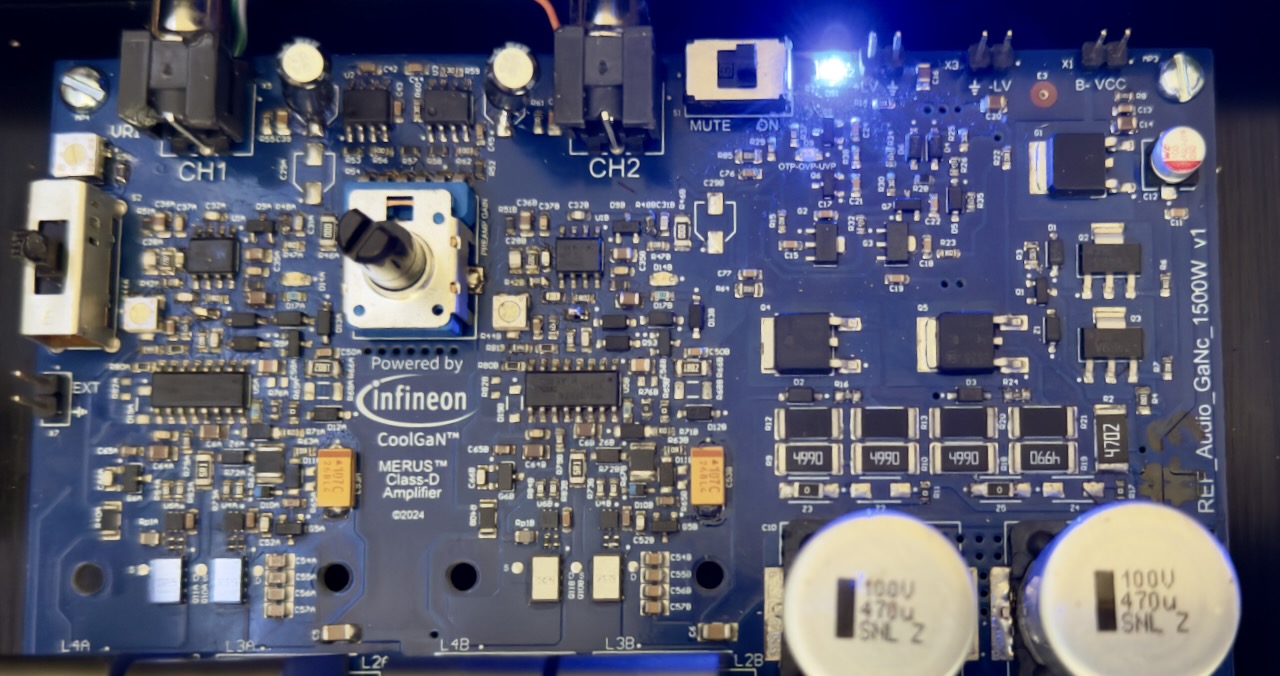
Photo above: Infineon CoolGaN Class D amplifier board.
"David Baker and I designed the board together. It was a year-long project completed in late 2025. Because GaN device operates at much faster speeds, we need to adapt new dimensions of circuit and PCB designs. Ultimately, we were very impressed by both its thermal performance and outstanding sound quality. "
"Powered by a 500 W DIY switched-mode power supply, the demo amplifier achieves massive power without a heatsink - not possible using even the latest silicon MOSFET. By switching at 1 MHz PWM, the amplifier achieves an exceptionally small form factor while delivering a very nice sonic result. Operating at one million samples per second, it provides a sampling density 2.5 times greater than previous designs."
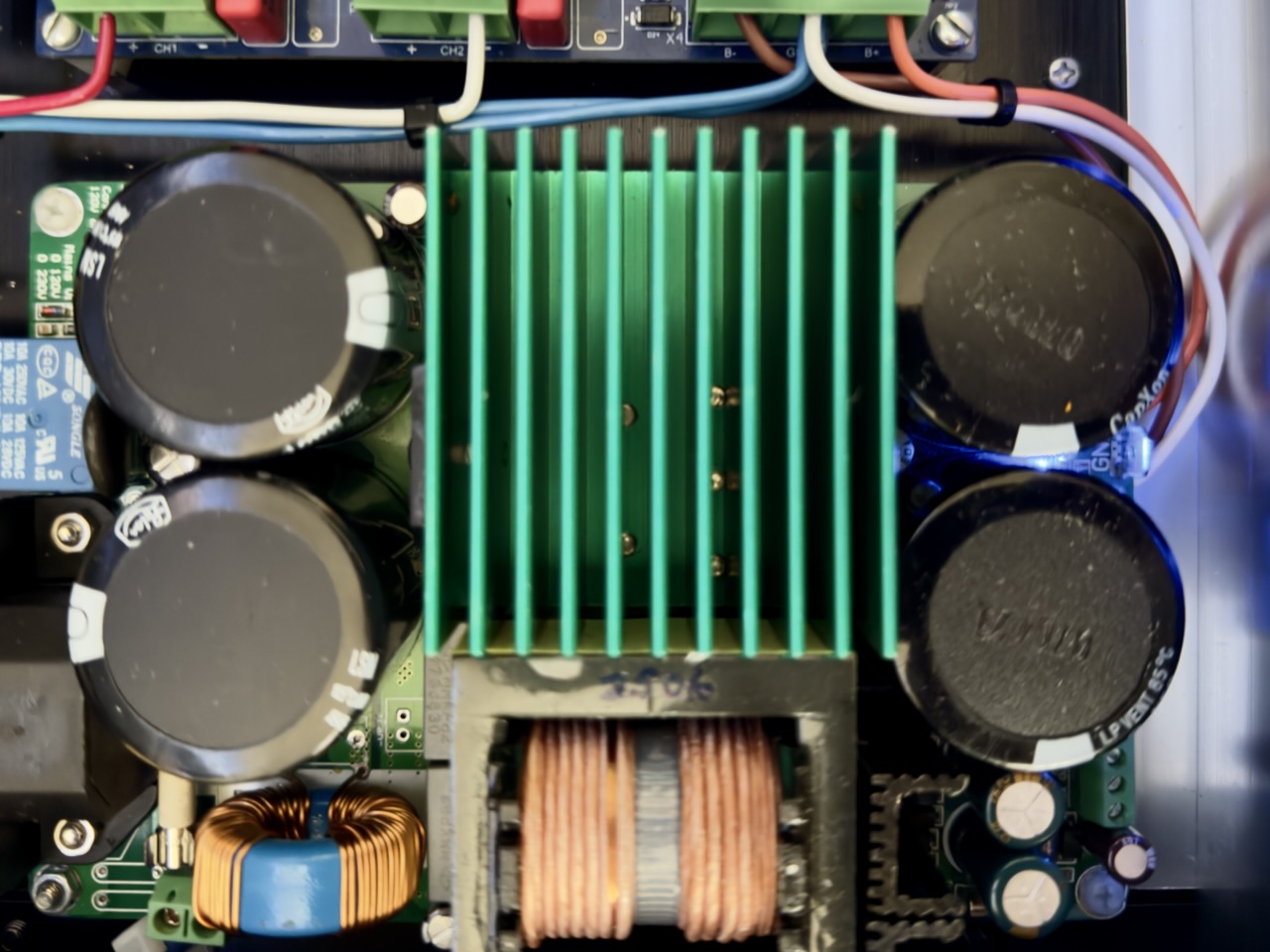
Photo above: DIY power supply.
Why GaN?
“Designing an audio power amplifier brings a tradeoff between output power capability and sound quality. In traditional Class D designs, power devices that are oversized for the target power operate slower and introduce more noise than an optimally sized power device."
"GaN HEMTs operate on fundamentally different physical principles, dramatically reducing these constraints. They switch significantly faster relative to their power capability. They also switch much cleaner by eliminating the reverse recovery effect – the primary source of high-frequency switching noise."
"Interestingly, GaN is a semiconductor that does not rely on traditional P-channel or N-channel materials to conduct current. Because the conducting layer of a GaN device features no impurity doping, electrons move freely without a scattering effect. This allows electrons to travel much faster, resulting in exceptionally high electron mobility. By contrast, traditional semiconductors depend on impurity to facilitate conduction. To use a conceptual analogy, it is like comparing standard copper wire to high-purity oxygen-free copper wire. Because of these unique physics, I think GaN transistors are fundamentally suited for high-fidelity audio amplification."
Is GaN the rebirth of triode?
"Class D amplifiers share fascinating structural similarities with classic vacuum tube amplifiers. A Class D amplifier with no feedback is fundamentally a voltage output topology. The voltage gain can be viewed conceptually as the amplification factor (µ) of a triode. Another similarity is that both topologies insert a magnetic component directly between the amplifier output and the speaker. In a tube amplifier, this is the output transformer; in a class D amplifier, it is the inductor of the LC-LPF."
"Zooming in to the device level reveals an even more interesting connection. The operating principle of GaN transistors functions remarkably like those of a triode vacuum tube."
"A triode relies on heater filament to boil free electrons off, then a positively charged plate (anode) to collect the electrons to flow electrical current. Because these electrons travel through empty space, they fly without colliding into physical matter. The triode is the original high-electron-mobility device. By inserting a mesh grid between the heater and the plate, a changing bias voltage modulates the amount of electrons, regulating the current output."
"A GaN HEMT replicates this environment within a solid-state crystal. By bounding a layer of AlGaN to a layer of GaN, the mechanical stress caused by mismatched atomic spacing induces piezoelectric polarization. This forces an ultra-dense pool of electron layer to form at the boundary. Like the grid in a tube, placing a p-GaN gate near this electron layer allows a control voltage to deplete or restore the electrons, regulating current flow."
"The triode uses intense thermal energy to force electrons into a vacuum; the GaN HEMT uses atomic pressure to isolate electrons, creating a pool of electrons within a crystal lattice. Both devices are natively fully conductive (normally-on) device when no grid or gate is applied. Because the conducting electron layer in a GaN device is completely undoped, the moving electrons do not collide with the chemical impurities found in silicon MOSFET structures. Instead, they glide through the channel without impurity scattering -as if they were traveling through empty space."
"By eliminating this internal atomic friction, the GaN HEMT functions as an intrinsic solid-state triode. Is the GaN HEMT a rebirth of the triode tube?"
A big "Thank you!" to Jun-san for telling us about the new Infineon GaN Class D amplifier.
I've installed the Infineon GaN Class D amplifier into my vintage Altec A5 Voice of the Theatre loudspeakers based audio-visual system to get some run-in time on it.
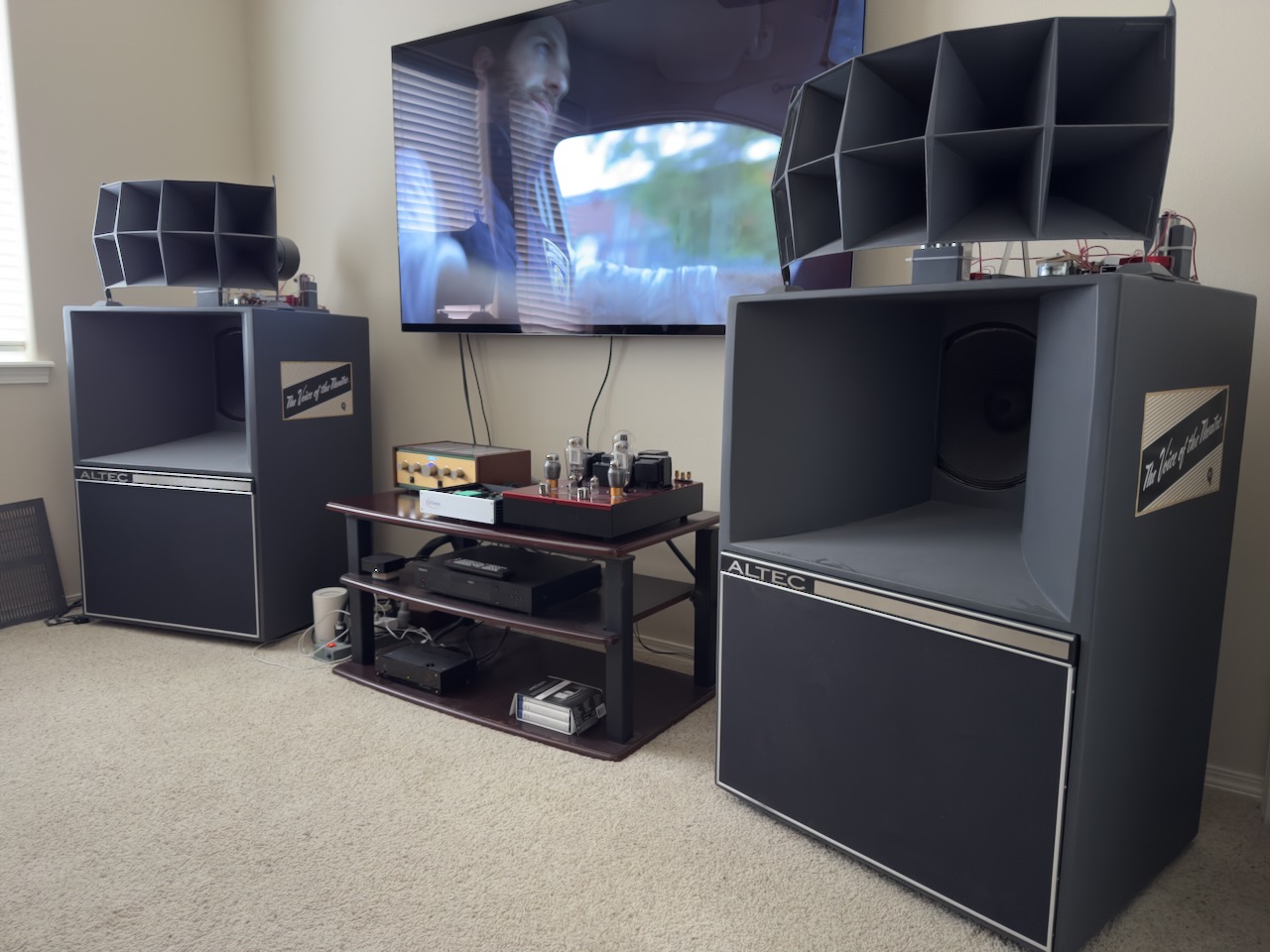
My plan is to rotate the GaN amp through my four audio systems so I can hear it in a variety of contexts. I plan on trying it with both a vacuum tube preamplifier as well as a solid-state preamplifier. I'll be comparing it to a SET amplifier, a push-pull vacuum tube amplifier, a solid-state conventional amplifier, and another Class D amplifier. I'll be using both digital and vinyl sources to get a feel for how it performs with both formats.
And of course, along the way I'll telling you all about what I find out about the GaN amp!
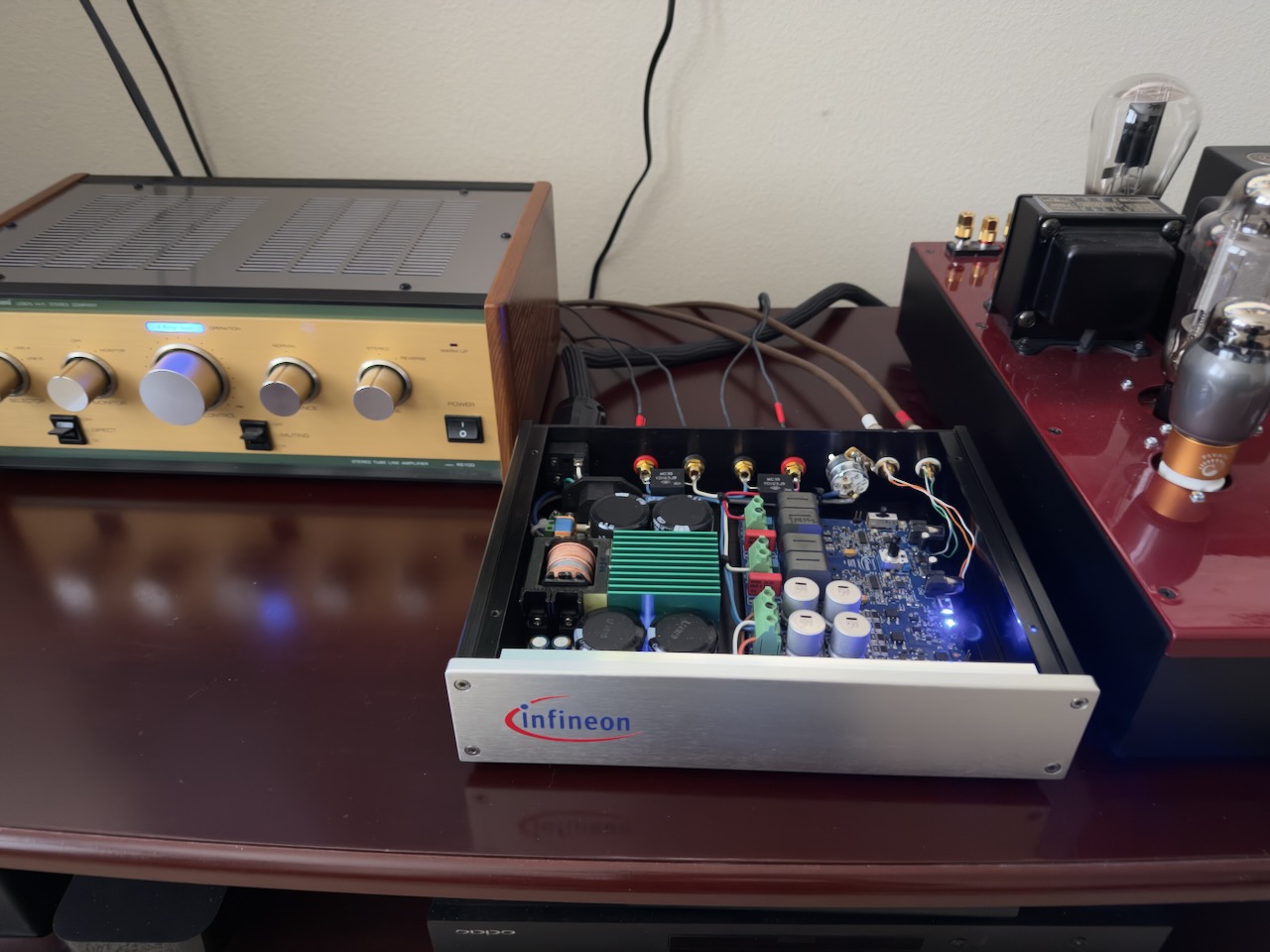
It's warming up now in my audio-visual system, and after I get some run-in and listening time in on the GaN amp, I'll report back with some first impressions.
Much more to come!
A big "Thank you!" to Jun-san for sending his GaN amp for me to listen to, and to Yazaki-san for suggesting the idea.
As always, thanks for stopping by, and may the tone be with you!