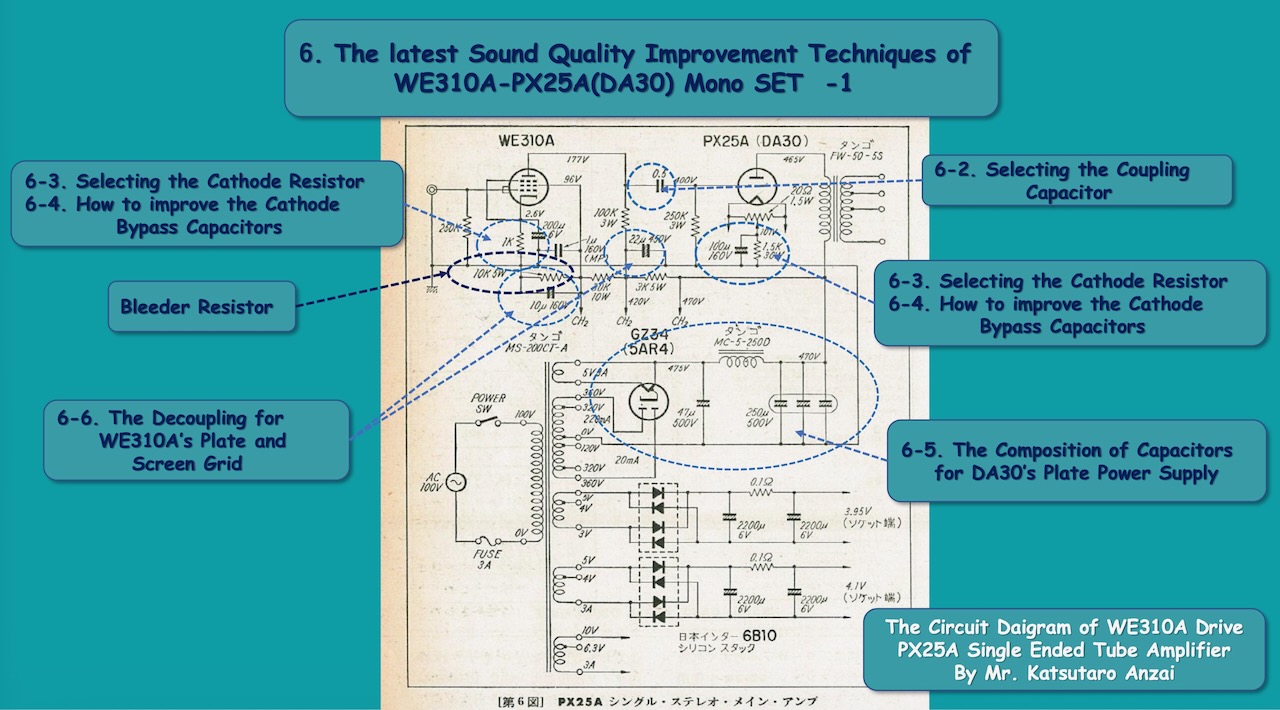
6. The latest Sound Quality Improvement Techniques of WE310A-PX25A(DA30) Mono SET
So, what impression did I have of the Ookubo-san’s WE310A-DA30 Mono SET, which I encountered again after 13 years? The surface was certainly a little dusty and dirty, but after removing the dirt and polishing it with cleaner, the beautiful, intricately patterned hammered finish was fully restored to almost the same condition as the original one. I was sure Alan-san would love it in this condition.
However, the inside of the chassis was fraught with problems, with the parts layout and wiring itself being somewhat messy, and there were also flaws in the selection of parts. Anyways, compared to the beautiful, well-organized exterior, I could only feel ashamed of my own immaturity at that time.
However, after assembling Ookubo-san's amplifier, I was fortunate enough to have the opportunity to build seven WE310A-DA30 mono SET sets, gaining a wealth of experience in improving sound quality.
During that time, I have been sharing these techniques with readers at Jeff's Place for nearly 10 years. And so, I decided to make the most of my experiences so far, make a version-upgrade modification up to date, and create the best-sounding amplifier ever experienced before.
6-1. Non-Feedback Circuitry or P-K Feedback Circuitry
Now, when it came to significantly improving the sound quality, I had to carefully consider whether I should proceed with a non-feedback circuit like the original design, or incorporate a P-K feedback circuit with slight feedback of 3dB. Because, as I mentioned in Part 4 six years ago, the sound and music produced by this P-K feedback circuit is rarely harsh, but rather is of extremely high quality and refined.
The following is an excerpt from Part 4:
“Fortunately enough, the sound quality of this -3 dB P-K feedback using the new dome type was unexpectedly splendid. As mentioned above, originally the quality of the non-feedback WE310A driving the PX25A (DA30) with the new type DA30 vacuum tube already reached an exceptionally lofty and organic tone, but I had never heard such a supremely noble and fine sound as I did with the -3 dB of P-K feedback. It could be said that if the non-feedback sound was like the scenery of an untouched and living nature, the sound with the -3 dB of P-K feedback was more like the truly comfortable life, where the richness of nature and moderate urbanization were beautifully fused. Of course, both are so fascinating. However, I felt that by reducing the 3rd harmonic distortion in the amplifier using -3 dB of P-K feedback, even the most minute harshness was eliminated from the amplifier.”
In fact, I incorporated a mechanism to select between non-feedback and -3 dB P-K feedback into the seven mono SET sets I built after this Ookubo-san's single-ended amplifier. But I tried to think of the positive sound characteristics of non-feedback once again. It's the three-dimensional sound field, and in particular the depth of space in front and behind, and the powerful sound that seems to jump out at me.
This is probably because, by not accepting the back-electromotive force from the speakers, the time axis, or the phase characteristics, engraved in the sound source signal, could be accurately reproduced. In particular, over the past three years or so, in my pursuit of the sound quality with the “iPhone Adventure”, I have come across and experienced high-quality streaming sources, such as recent digital live or very simple recordings.
Indeed, these sources delivered a clearer, more immersive, and more detailed sound field than any other I had ever heard before. In other words, I realized that the iPhone Adventure and non-feedback amplifiers are an excellent match when it comes to sound field reproduction. Or perhaps a more accurate way of putting it is that new streaming audio sources have excellent phase transfer characteristics, offering the potential to elevate the music reproduction capabilities of subsequent speakers to a new level.
What really brings out the best in these innovative music sources would be the oldest type of non-feedback tube amplifier circuit, which isn't affected by subsequent speakers. So, instead of incorporating a selectable function between non-feedback and P-K feedback, I decided to pursue new possibilities for improving sound quality by using only a non-feedback circuitry, originally designed by my master, Anzai-san, more than half a century ago, in the “MJ” July issue in 1972.
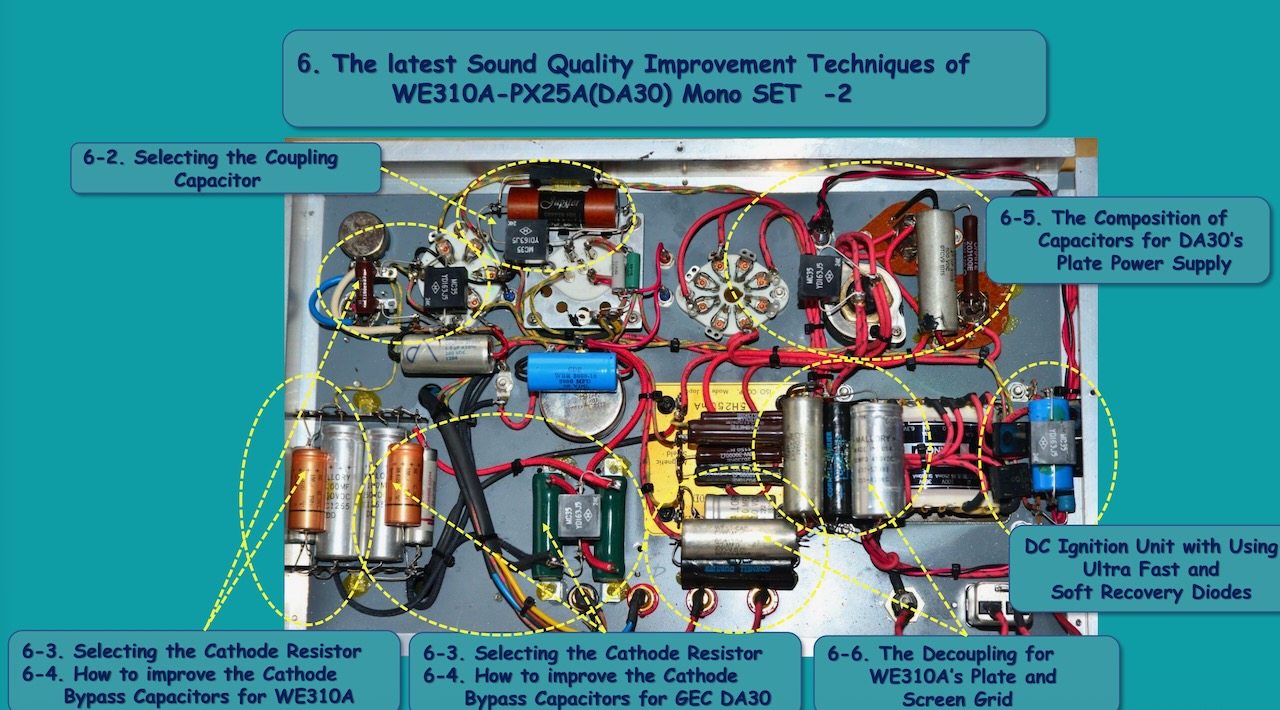
6-2. Selecting the Coupling Capacitor
Now, located between the plate of the WE310A driver tube and the grid of the PX25A (DA30) power tube is the coupling capacitor that forms part of the high-pass filter. This capacitor is essential not only for this amplifier but for CR-coupled tube amplifiers in general.
The amount of signal information transmitted by this element and the distinctive tonal coloration it adds have a major impact on the final sound quality, or character, of the tube amplifier. That's why we must select and use the best capacitors for this coupling capacitor, both in terms of physical properties and sound quality.
Now, I'm going to digress a little, but what I really want to say here is that high-output vacuum tube amplifiers with push-pull or multi-push-pull configurations naturally use multiple coupling capacitors on each channel, and as a result, these multiple high-pass filters cause significant loss in the music signal and changes in tone when the signal is amplified.
Unfortunately, in today's audio world where low-efficiency speakers dominate the market, it's no exaggeration to say that single-ended tube amplifiers like this one, which use only a direct-heated power triode with a maximum output of around 10W, could be no longer relevant.
However, when combined with the high-efficiency speakers of the past, the signal amplification circuit is extremely simple, so the amount of musical information lost would be minimal, and so I'm confident you'll enjoy not only a more nuanced, more realistic, and faster-attack sound but also true musicality with such a system. Of course, I think this is also due to the higher initial sensitivity that is unique to high-efficiency speakers.
Anyways, choosing the right coupling capacitor for the new Ookubo-san’s amplifier was an important issue in pursuing sound quality and musicality. Well, about 10 to 15 years ago, I had been involved in releasing hermetic seal, oil-filled capacitors with a sound that I found desirable.
It was the result of the nice collaboration with Arizona Capacitors, Inc., the successor to the former WEST CAP, which is still now famous for its splendid sound. These capacitors were named Red Cactus, Blue Cactus, and Green Cactus, after the symbol of Tucson, Arizona, where they were produced.
I have written extensively about the Cactus series in my previous posts on Jeff's Place, so I won't go into detail here, but I believe that Red, Blue, and Green Cactus each have unique positive sound characteristics, and that is why they still have a place as excellent capacitors.
Unlike the later seven-sets, the Ookubo-san’s mono SET amplifier originally did not have an octal plug mechanism for switching between three or four types of capacitors, so I had to select just one type of best-sounding capacitor.
The capacitor I chose this time was Jupiter Copper Foil, Paper & Wax 0.47 µF / 600 VDC. Of course, I also connected two Ultimate Ruby Mica, 0.016 µF in parallel to ensure flat E.S.R. characteristics up to ultra-high frequencies above 1 MHz, making it the best coupling capacitor currently available.
My honest recommendation of this Jupiter Condenser is available online, so I'd like to summarize its sonic features here. In any case, I would like to express my sincere respect and gratitude to Mr. Christopher Young of Jupiter Condenser for developing such a wonderful and outstanding capacitor. Link HERE.
“First of all, I want to make it clear about the Jupiter Copper Foil, Paper & Wax: the sound of this capacitor is perfectly in line with the "Real Sound" I've been pursuing for many years. The contrast in tone is exceptionally high across the entire frequency range, and the richness and thickness of the sound, especially in the mid-low range, is captivating, condensing the musical energy. The sound is also full of momentum and dynamism. In other words, the primary requirement for a signal capacitor is the amount of information transmitted. Naturally, the amount of information is enormous, from the low to high frequencies. This is what makes music sound so rich. Perhaps it's more like a sound that allows you to immerse yourself in the music and relax, rather than the sound itself. From a technical and qualitative perspective, the high-purity copper foil and silver lead wire minimize E.S.R., the electrode resistance component, while the wax used in Jupiter capacitors effectively damps the vibrations of the copper foil. Finally, paper, a natural material, is a dielectric that brings warmth and naturalness to the sound. Of course, cylindrical Bakelite is also an acoustic material with an excellent balance of strength and internal loss. These factors likely contribute to the excellent sound quality of Jupiter's copper foil, paper, and wax.”
Please click on the link below to go to the next page.