

What I want to emphasize to everyone is that by the late 1950s, the technical requirements for a cable capable of transmitting both minute voltages and minute currents or even minute voltages and large currents without any loss had already been clearly defined and perfectly realized in this world.
Even though the market is now flooded with extremely expensive audio cables with a wide variety of characteristics, I would like everyone to recognize the fact that boasting extremely ideal physical properties and sound quality cables like Belden 8402 and WE16GA already existed before us. So why not start your audio-life by trying these cables as your reference? I believe that the most basic thing you need to start your audio quest is to choose such reliable cables that have been around for over half a century.
Now, I'd like to talk about the true vintage tubes, the most important and rare components that characterize the basic sound of this amplifier. My master, Anzai-san, the designer of this amplifier, described this about the driver tube, WE310A:
“The greatest feature of this vacuum tube is that it has a gain of 40 dB and yet can produce an output voltage of 100V, making it rare to find such a vacuum tube across all ages and countries. This powerfulness can be seen as the effective use of quite large heater power of 10V/0.31A, 3.1W as a driver tube”.
As I've mentioned before, there are three types of WE310A tubes that are clearly visually different depending on the era they were produced in, which are Mesh Shield, Small Punch, and Large Punch.
Mesh Shield type was the oldest version and produced up until the 1940s, Small Punch in the 1950s, and Large Punch from the 1960s onwards.
Each has a completely different sonic character and Ookubo-san and I had believed that the value of Mesh Shield is outstanding and irreplaceable. The beauty and the smoothness of its expression of musical nuances set it far apart from the small and large types.
However, one weakness is the brittleness of the adhesive on the grid cap from this era, which often becomes loose in some way. This is why it is necessary to apply epoxy resin adhesive to the outer edge of the top grid and the glass of the tube. Aside from that, I've luckily owned nearly 10 units of WE310A Mesh in total, including both top-printed and engraved socket versions and my experiences have shown that they are far more reliable over long periods of use than Small and Large Punch.
Well, I would like to recall my memories from that time of collecting extremely rare and valuable these tubes for Ookubo-san. For example, I found the WE310B engraved on some shop's website, and it was the first time I had heard of the existence of a tube that was completely compatible with the WE310A. And upon further investigation, I discovered that it was a low-noise version of the WE310A. Ookubo-san was immediately interested in this story, and the two of us traveled to the shop, “Western Labo”, which was located in a remote location, just under an hour's drive away. 真空管 - ウエスタンラボ オンラインショップ
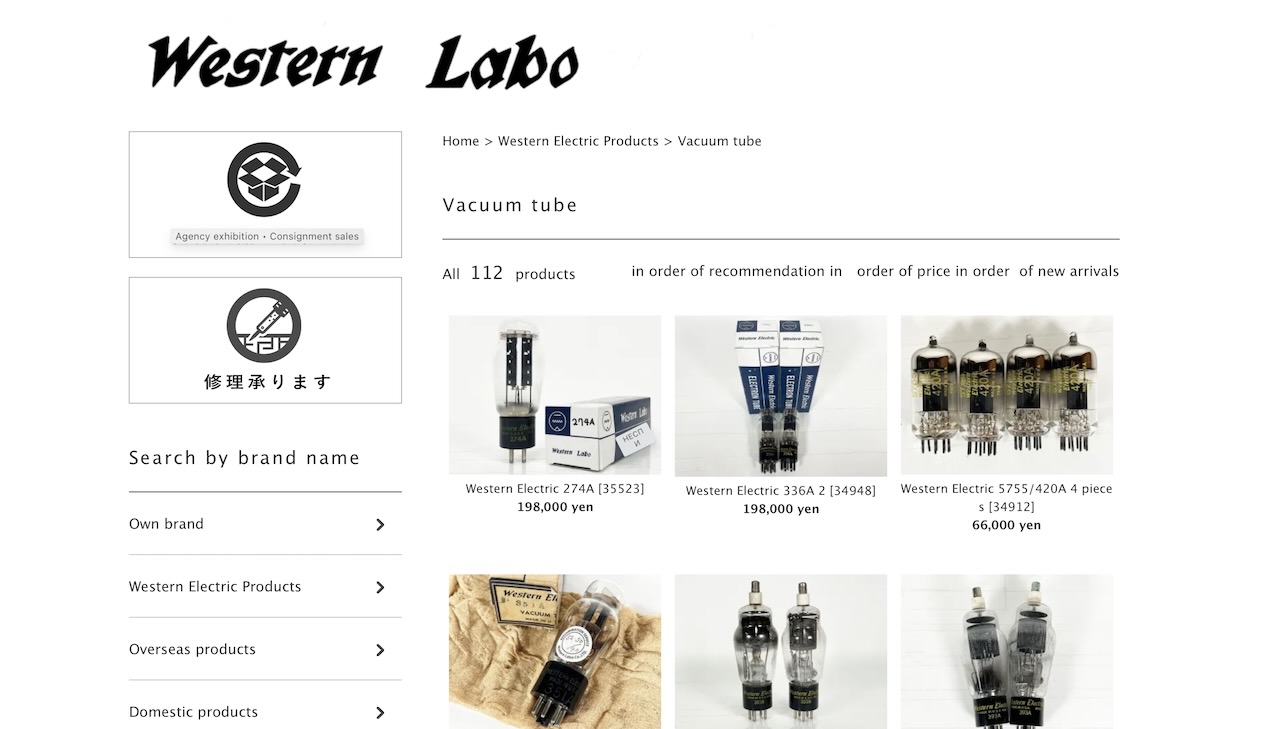
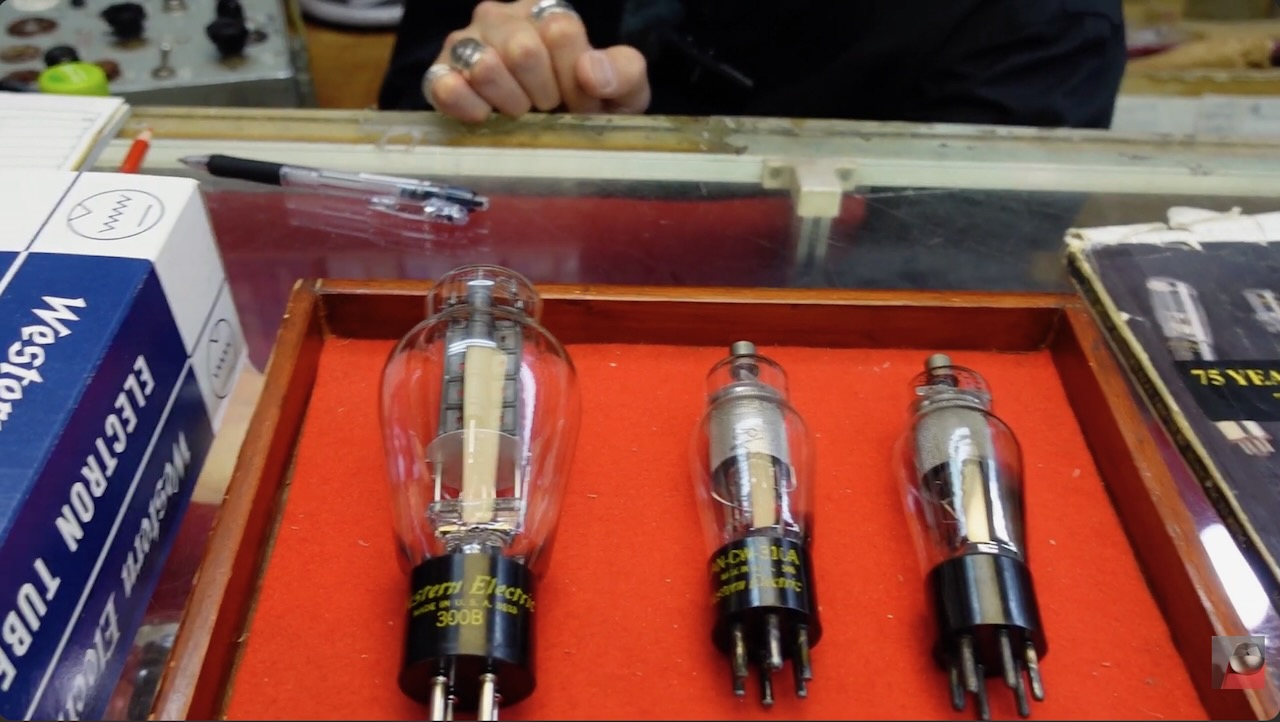
This unbelievable shop was like a treasure trove with all kinds of vintage audio equipment, mainly made in the USA. Since the amplifiers and the speakers were preserved in working condition, we could actually listen to them and check them out. Ookubo-san managed to purchase all three of these tubes, which were very expensive even at the time. I never expected to encounter these rarest tubes again after 13 years passed. At the end of January this year, so I was very moved to be able to get my hands on these three tubes, WE310B engraved. As you'd expect from Western Electric tubes, they were in perfect working condition despite the fact that Ookubo-san must have used them for a long time, so I was amazed once again at their highest reliability.
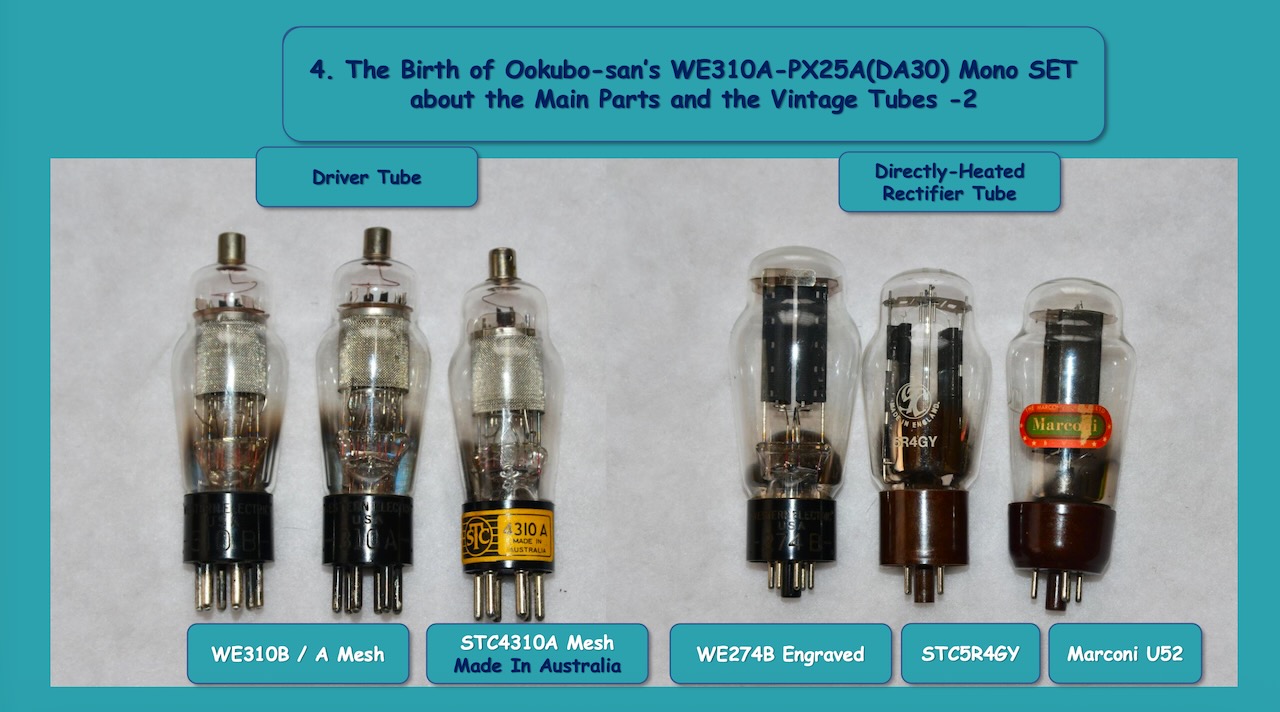
Well, I’d like to take this opportunity to introduce the STC4310A or STC4328A (7.5 V version) from STC (BRIMAR), the UK patent holder for Western Electric tubes. These are truly one of the rarest tubes, but there is also a mesh-shield version produced at STC's Sydney factory in the early 1960s. This is a very beautiful-looking tube, and the mesh-shield version also has the virtues unique to STC tubes, particularly its excellent high-frequency reproduction ability and produces a very elegant tone. So, I can distinguish the sound, or perhaps even the tone, of the WE310A/B mesh and this STC4310A/4328A mesh, but honestly, I can't tell which would be better.
Of course, I accompanied Ookubo-san when he acquired the most famous rectifier tube, a pair of WE274B engraved, which has been known as the “Holy Grail” in the tube world, from a tube specialty store in Akihabara / Tokyo. 300B 1988年製 NOS管 ウエスタンエレクトリック 銘球紹介① 真空管の長谷川 再販品では味わえないオリジナルのウエスタンの音を奏でる逸品! また、アーティストの方が発想されたアームも紹介!
Ookubo-san also acquired three of these tubes, and I was able to borrow one of them from him for two and a half years, allowing me to literally experience the essence of the vintage Western Electric sound. The sound of these early Western Electric tubes has a common deep, fully nuanced tone, supported by a thick, dense mid-low range, which gives it a unique charm that allows us to immerse ourselves in the music with peace of mind and relaxation.
In other words, I can't help but feel that those sounds have a certain universality that does not go against some indescribable human sensibility. And when I reflect on the absolute fact that these tubes, WE310A Mesh and WE274B engraved with such wonderful, supreme musicality, were manufactured 80 years ago, I am always overcome with a deep sense of respect and gratitude for our predecessors, especially the engineers of Western Electric.
Now, I'd like to once again express my personal opinion about the GEC PX25A (DA30) direct-heated triode power tube, which characterizes the sound and tone of this amplifier. When it comes to directly heated triode power tubes, it's unlikely that anyone with an interest in tube amplifiers will be unfamiliar with the name Western Electric 300B, commonly known as WE300B.
However, I believe that even today, the existence of the GEC DA30, which offers performance equal to or even exceeding the WE300B, is largely unknown among tube amplifier fans around the world. The situation was similar when I was in my early twenties, during the vacuum tube amplifier boom in Japan in the early 1970s. American-made tubes such as those made by Western Electric and RCA were already well known, but vintage UK tubes were virtually unknown.
Now, the person who brought about a decisive change in this situation was a French-Japanese man named Mr. Jean Hiraga. I remember it was in the early 1970s that young Hiraga-san opened a tube import trading company called “Sansei Enterprise” in “Kobe” city and was the first to introduce especially vintage made-in-UK and West Germany tubes to Japan. In later years, after he moved to France, his audio-related reviews, publications, and recommendations accompanied by actual products became well known to us tube amplifier fans, but I believe that his educational activities as an importer in Japan were his starting point.
At the same time, the specialized audio technique magazines “Radio Technology” and “MJ” had published a lot of monthly articles by their main writers about DIY builds using these tubes, and the tube amplifier boom in Japan reached its peak, and it had continued throughout the 1970s. In any case, even someone like me at that time, who had barely had any experience with vacuum tubes, was thrilled by the encounter with these newly discovered made-in-the-UK tubes.
This was because the magazines were starting to widely circulate rumors that direct heated output tubes such as the PX4, PX25, and PX25A (DA30) had a different tone from our familiar made-in-the-USA triode, RCA2A3 and WE300B that people had heard of and admired up until then, and that in some cases they might even produce an even better tonal quality.
Especially, DA30, with its characteristics fully comparable to the WE300B, attracted particular attention, and some magazine articles described that even if WE300B is likened to a king, DA30 is likened to a queen, and so the tube enthusiasts in Japan at the time were fascinated by the late appearance of DA30 direct-heated power triode.
As a result, during Japan's period of rapid economic growth in the 1970s and 1980s, in other words, when Japan greatly increased its national power, it appears that almost all surviving PX25A/DA30s in the UK had been snapped up by Japanese buyers. And this would probably be why the DA30 can currently only be found on Japanese auction sites, even if we search the world over.
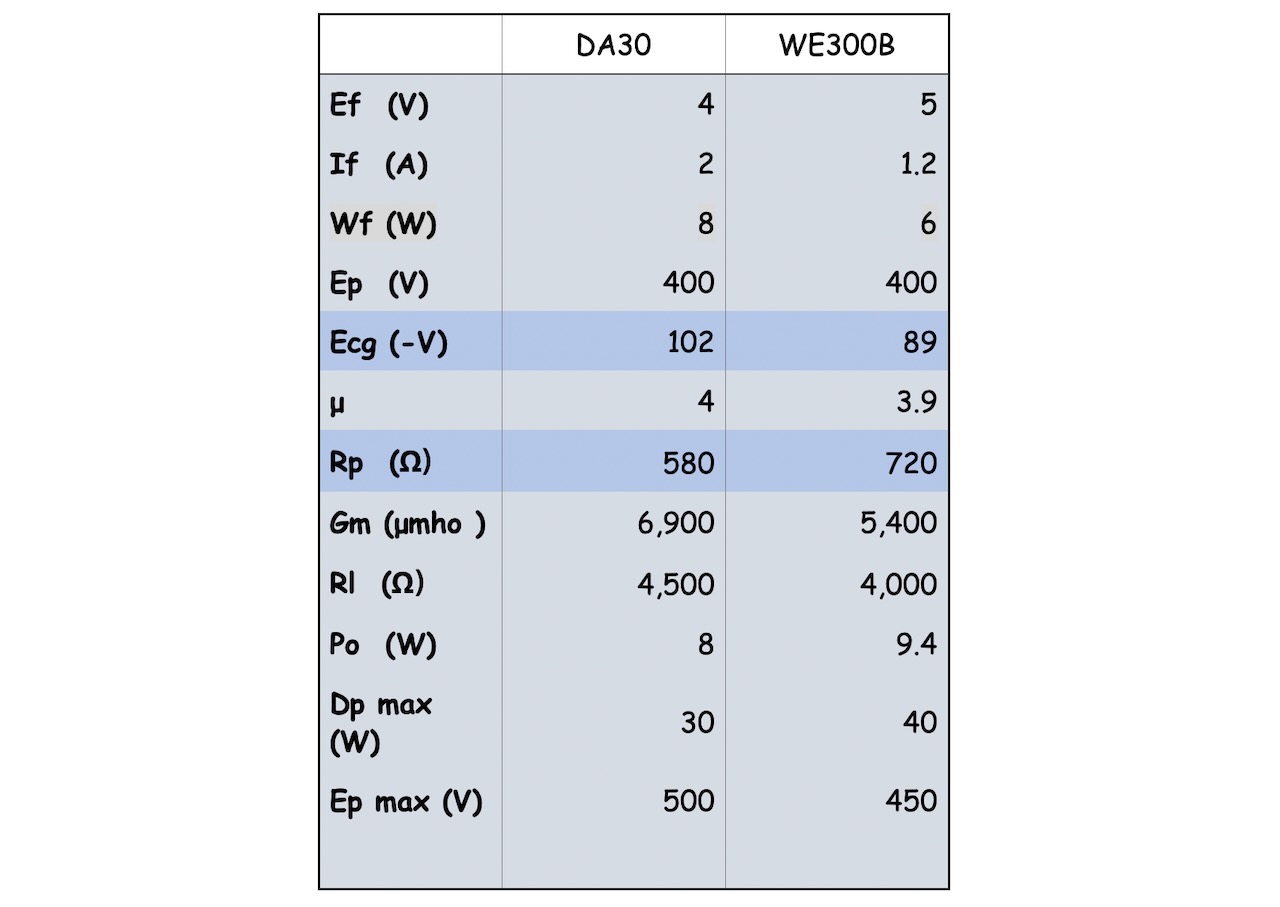
Now, let's compare the specifications with the WE300B and clarify the characteristics of the DA30 power tube. The table below is an excerpt from Mr. Naoki Watanabe's article, "How to Use the DA30 High Bias Voltage European Triode," published in the August 1988 issue of “MJ”.
Well, Mr. Naoki Watanabe was apparently friends with the aforementioned Mr. Jean Hiraga and is considered one of the few authorities on European vacuum tubes in Japan. He described in the article that:
"This comparison table shows that while the WE300B is superior in both plate efficiency and filament efficiency, but the DA30 is superior in the lower plate resistance Rp value, which is the most important factor for a triode. (Yazaki note: This is the output impedance value of the tube itself and the smaller the value, the better the driving characteristics for the output transformer in the subsequent stage. In other words, the output impedance of an amplifier using this power tube will be lower, meaning the damping factor will be higher.) Furthermore, a tube with a high Ecg (grid bias voltage) is difficult to drive, but such tubes have traditionally been considered to have good sound quality in Japan. The reason for using a tube with a high grid bias like the DA30 is none other than its excellent sound quality. It's true that it seems to be overshadowed by the WE300B, but the DA30's distinctive clear European tone offers a unique character that can't be found in the sound of made in the USA tube, WE300B.”
“In addition, the shape of later PX25A / DA30 was changed to a dome shape, and the electrode structure was changed to a tetrode structure with an auxiliary electrode, reducing the capacitance between the internal electrodes. This is an improvement that will come into play when used in the radio frequency band but there doesn't seem to be any change in the audio frequency band.”
However, the latter part of Watanabe-san's statement differs from my own understanding. This is because the sonic characteristics of the old valve-shaped tube and the newer dome-shaped tube are completely different, I’ve felt. The sound of the old DA30 pure triode tube, driven by the WE310A and with no feedback, is more than adequately in the mid-low range, but the high frequencies sound a bit rounded.
This is certainly attractive in its own way, but the new dome-type DA30 vacuum tube has excellent high-frequency extension even with no feedback, which I believe is comparable to that of solid-state amplifiers with excellent high-frequency characteristics.
Even when driven by WE310A, which has a high output impedance, the new DA30 dome-type tube has small stray capacitance between the grid and cathode, because of its tetrode structure, allowing for nearly flat reproduction across the audible range.
In Part 4 (HERE), Mr. Atarashi, the main writer for “Tube Kingdom”, reported that when driving WE300B amplifier with WE310A, the pure triode WE300B required 10dB P-K feedback to reproduce music enjoyably.
However, with the DA30's new dome-type tubes, even without any feedback, there is no collapse in the high frequencies; rather, I can fully enjoy the wonderful qualities of a non-feedback amplifier, such as a rich and true three-dimensional sound field expression.
I've been using the DA30's new dome-type tube for over half a century, and I still haven't felt any dissatisfaction or deficiencies with the sound, and I'm sure the same was true for my kindred spirit, Ookubo-san, but also Alan-san would have experienced and felt it in his daily listening session.
Please click on the link below to go to the next page.