
4. The Birth of Ookubo-san’s WE310A-PX25A(DA30) Mono SET about the Main Parts and the Vintage Tubes
In any case, through direct conversations, frequent phone calls, and emails, I found that Ookubo-san had similar audio tastes and inclinations as I did, and our mutual friendship quickly deepened.
I recall that it was around the end of 2011 when Ookubo-san asked me to build a single-ended amplifier of GEC PA25A(DA30) driven by WE310A. Of course, at the time, Ookubo-san had multiple opportunities to listen to the sound of my DA30 stereo power amplifier, which drove the ONKEN New 500MT mid-high horn driver and the rare ONKEN 5000T Esprit tweeter, and I'm sure he really loved it.
Finally, he must have made up his mind and asked me to build it for him. I believe this was a big decision and offer that Ookubo-san made only because of his trust in me. While this was a very welcome offer for me, I had some serious reservations about going ahead with it. The WE310A drive PX25A stereo amplifier, which I built up for myself, was from 1972-1973, so it was already 40 years past, and I wasn't sure whether I would be able to obtain such rare vintage tubes in good condition and also the top-quality transformers at this point.
Naturally, I wasn't sure when the completion date would be and how all of those parts would cost in total. Even so, Ookubo-san was understanding of such a negative situation. After thinking about it for about a week, my mind naturally began to solidify, and I decided to accept his offer. It was a decision that required determination for me, but to be more honest, rather than responding to Ookubo-san's passionate hope, I was only wishing to sublimate my own creative desires in the process of making that single-ended power amplifier. And now, I felt about myself that I had just become more of a craftsman, striving to perfect the art of manufacturing rather than an engineer I had been until then.
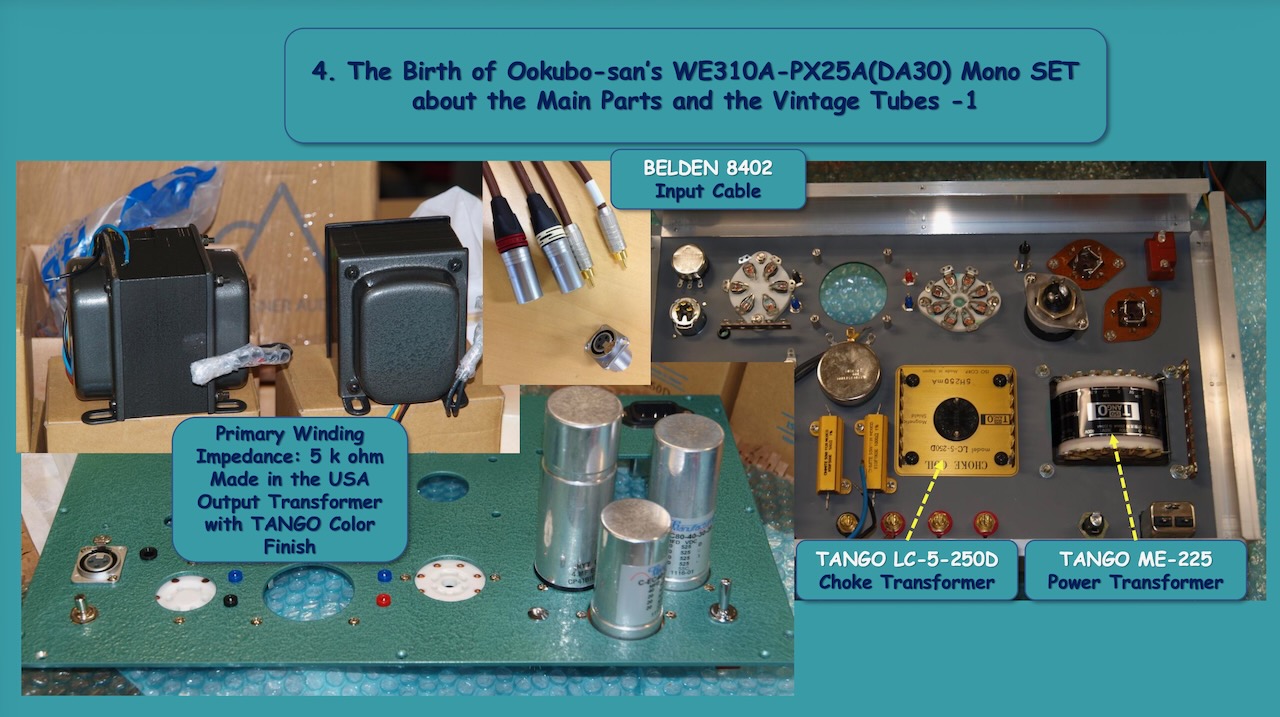
As 2012 began, the process of deciding on the rough specifications and selecting major parts began to progress rapidly. First of all, Ookubo-san himself wanted the best possible sound quality, and I myself was unwilling to compromise on that, so we decided on a mono configuration consisting of two identical amplifiers, rather than a stereo configuration.
While this would ultimately require two power transformers and two choke transformers, making it more expensive than a stereo configuration, I imagined that it would make it easier to arrange the internal resistors and capacitors and make up the wiring for them.
The next major challenge was finding a workshop to commission a custom-made chassis for the amplifier itself. At the time, it seemed that “Valves’ World” was the only workshop in all of Japan that would be willing to undertake the creation of the beautiful, one-off chassis I had in mind. Valves' World ギャラリー2007
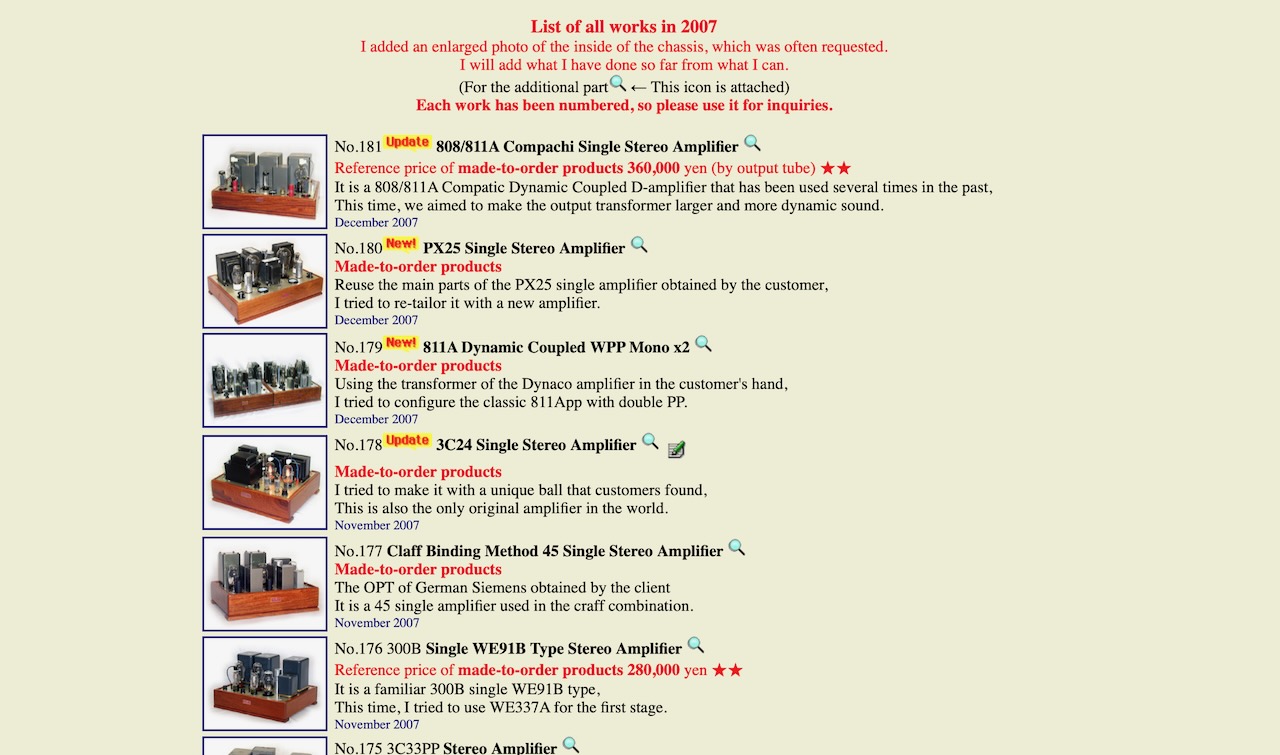
Well, so sorry for that, “Valves' World”, the workshop that brought these beautiful tube amplifiers to the world, unfortunately no longer exists now, because of both the first master and the second-generation master, with whom I had later worked, having passed away.
Anyways, with the strong support of Ookubo-san, I immediately approached Mr. Yokoyama, the second-generation master of the shop, to see if he would accept our requests to manufacture a pair of custom-ordered chassis, including a wooden case. Here were the specific requests below:
1. I would like to select and arrange all of the tubes, the transformers, and the other components, as well as create the initial drawings. And I would like Yokoyama-san to incorporate these into the machining drawings.
2. I would like to solder the internal wiring, and have Yokoyama-san process and manufacture the chassis only. And the chassis should be basically made of aluminum, with the top panel made of a 3 mm thick duralumin-based material due to the high processing precision and strength.
3. I would like to have it painted with a hammered finish. As for the paint color, I would like it to be close to the “ALTEC Green” used on early models of ALTEC woofers, etc. Therefore, I would like to import the spray cans from the United States, which I will select and provide to you.
“Valves' World” was basically a workshop that made one-off vacuum tube amplifiers, but after numerous phone calls and emails, Yokoyama-san understood my needs and, thankfully, accepted all of my requests.
Well, the reason I specifically wanted hammered finish on the top panel was because I loved its beautiful, subtle variations in its mysterious color and texture, but also because I hoped that this thick paint film would help dampen minute mechanical vibrations.
However, it seemed that demand for hammered finish itself had already been declining, and there were no spray cans in the colors I wanted in Japan. At the time, I came across the spray cans of hammered finish paint from the American company “Rust-Oleum” with dark blue-green and pale green, and I bought them and tried painting myself.
By first painting with the dark blue-green spray can and then the pale green on top of that, I found that a complex pattern and an indescribably elegant green color could emerge, and although it could not be said to be a true reproduction of “ALTEC Green”, I was sure it would be a beautiful amplifier.
The chassis was constructed from an aluminum material because it is not a ferromagnetic material like iron, and aluminum's balance of strength and internal loss makes it effective at damping vibrations. The power transformer is a source of mechanical vibration inside the amplifier, and the minute vibrations it generates are transmitted to the large electrolytic capacitor in the power supply.
Then these vibrations would be transmitted to the aluminum can, which is the negative electrode, potentially modulating the current flowing from the capacitor. I’ve believed that not being modulated by even the smallest signals would be the first step in creating my “Real-Sound”. And of course, the 3mm thick top panel was designed to have sufficient strength to firmly support the three heavy transformers: a power transformer, a choke transformer, and an output transformer.
At the same time, I was also collecting the main components that would be mounted on the top panel. One major breakthrough was my encounter with a made-in-the-USA output transformer with an unknown brand. This may have been a stroke of luck, but while it was relatively easy to obtain a transformer for a single amplifier with a primary impedance of around 3.5 kΩ for the WE300B in Japan, it was rare to come across a 5 kΩ transformer, which is considered optimal for the GEC PX25A (DA30). I just found its advertisement on the website of a small workshop that also sells homemade amplifiers.
As you know, the output transformer would be a major factor that determines the sound quality and its characteristic of an amplifier, and in fact, from my experience, it must be no exaggeration to say that it could determine the upper limit of the amplifier's potential for sound reproduction.
However, in reality, it would be impossible to evaluate the sound quality until the output transformer is incorporated and the amplifier is completed. Therefore, selecting an output transformer involved a certain element of gambling. But what attracted me to this American-made transformer was its rugged, bare appearance and the fact that it wasn't housed in a designed outer case. More than anything, I was overwhelmed by the huge size of the iron core.
In fact, the WE310A-driven PX25A stereo SET I completed in early 1973, based on a design by my Master Mr. Katsutaro Anzai, was equipped with TANGO FW-50-5S, a large, filled-with-good-amateurism output transformer that TANGO had finally introduced to the world at the time. It was a perfect match for the new GEC DA30 tubes, which had a lustrous mid-to-high range, and I have never had any discomfort or dissatisfaction with the sound quality, constantly enriching my audio experience for a long time. But the FW-50-5S weighed approximately 4 kg, and this unbranded, made-in-the-USA output transformer weighed in at a whopping 5 kg, despite having almost the same volume.
I've learned from my predecessors in specialist magazines like “MJ” that "low power loss transformers allow for better sound isolation from speakers, meaning they are more likely to produce a powerful sound, and that the output transformer of a single-ended amplifier in particular has an AC signal current superimposed on DC, and that this DC current runs the risk of magnetizing the core material."
For this reason, I have believed that a larger iron core would be essential. It would be true that a larger core could ensure the necessary inductance with fewer windings, which means the DC resistance of the copper wire would be lower and the power loss would be reduced - this qualitative logic was easy to accept for me.
In any case, I decided to get hold of a pair of output transformers, although their origins were unknown. And I'll reveal what kind of sound these transformers produced and how they played music in a later section.
Now, one more speaking of transformers, I'd like to talk about the choice of power transformer. Fortunately, TANGO was still in business in 2012, so I was able to get hold of an excellent power transformer, ME-225. The key points when selecting a power transformer would be perfect electromagnetic shielding and sufficient power capacity, and the TANGO ME-225 more than satisfied both requirements.
In particular, the WE310A's top grid has high impedance, and the surrounding cable also acts as an antenna, making it prone to picking up irregular noise. Therefore, if the power transformer's electromagnetic shielding is imperfect, we have no choice but to use a grounded shielded cable. Furthermore, the extractable current capacity was said to be 250 mA when rectified by a rectifier tube, but in this independent mono specification, the effective current load would be just under 100 mA, so this power transformer, TANGO ME-225, had plenty of margin. There also appeared to be a sufficient amount of filler between the outer case and the transformer body to create a tight seal, which should be effective in absorbing the mechanical vibrations common to power transformers.
One vivid memory from the collaboration with Ookubo-san was my encounter with BELDEN 8402. I had considered the input cable to be a part of the overall sound design of the mono SET for Ookubo-san. However, choosing this cable remained a headache even in the final stages of parts gathering. It was early summer 2012, around the time that Yokoyama-san of “Valves' World” was devoting all his energy to drilling holes in the top panel. One day, I was checking out BELDEN cables at TOMOCA, a famous pro audio shop in Akihabara, Tokyo. That's when I spotted the 8402 with its unfamiliar brown outer jacket next to the BELDEN 8412 that I had often used myself. The only difference between the 8402 and 8412 seemed to be the jacket material, which was a high-quality Hypalon, while the other was made of a urethane-based rubber.
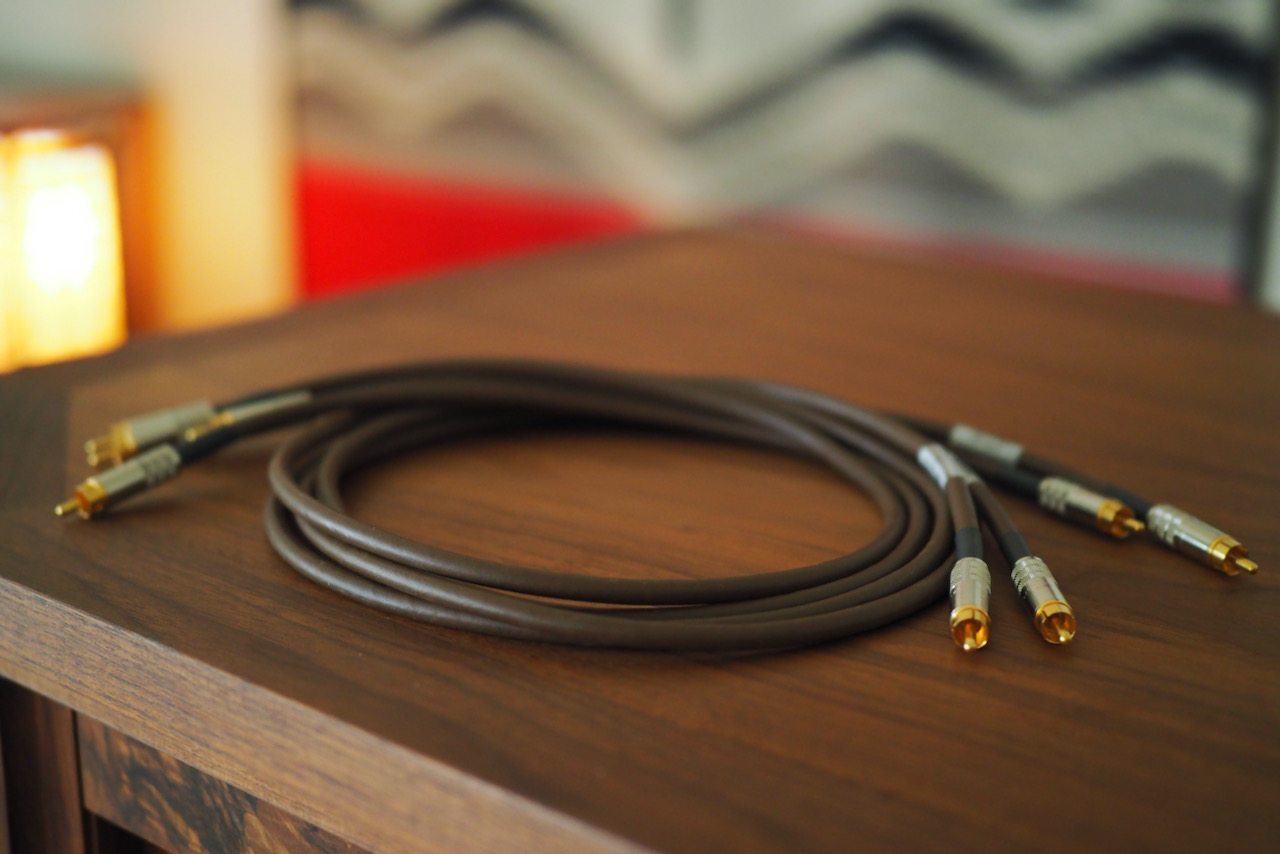
I quickly assembled an interconnect cable with RCA plugs on both ends and at first asked Ookubo-san to evaluate the sound. Fortunately, his first impression was extremely positive: "It's wonderfully elegant and perfect." I also tested it myself in my home system and as soon as I listened to it, I immediately recognized that I had reached the goal, just as I had been long seeking for.
My first impression was here; the slight thickness in the low-midrange and roughness in the high range that I had experienced with BELDEN 8412 were completely gone. Instead, I felt the sound energy in the entire frequency range was flat and also it had the delicate, smooth, refined tone, yet very powerful in the low-range, and just as Ookubo-san had pointed out. Although it was a genuine made-in-the-USA cable, its sound might have some universal character that seemed to fit any type of music all over the world and I confidently decided to adopt it as the custom input cable with XLR plug and RCA plug for the mono SET.
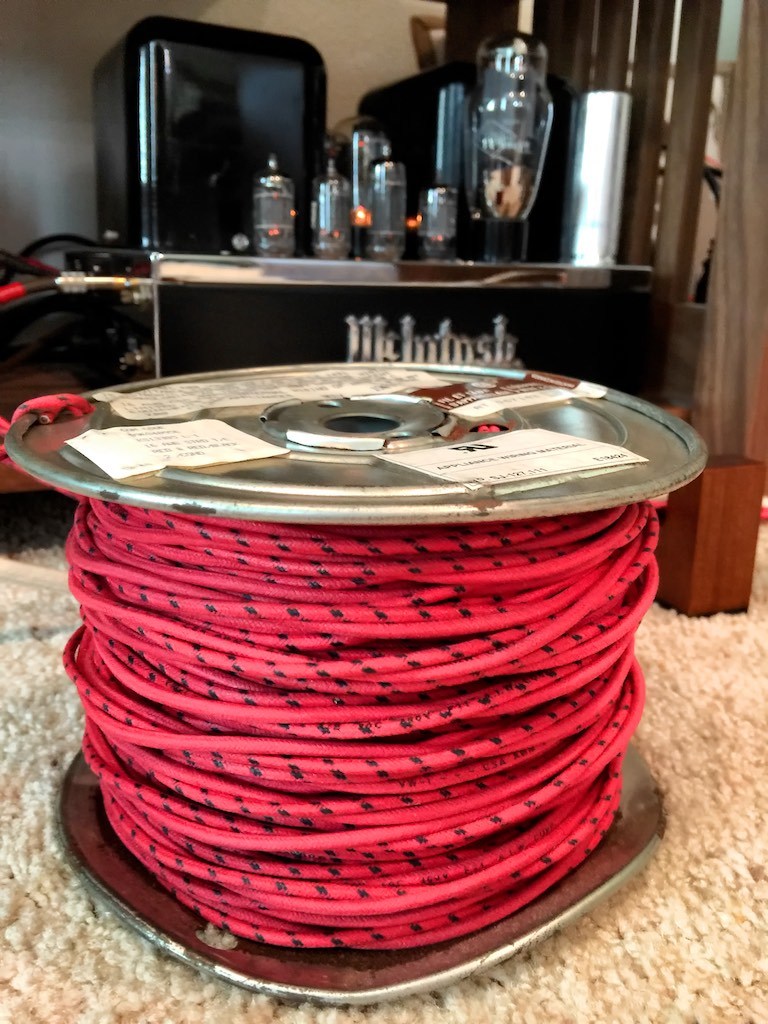
Since then, all of the interconnect cables that Ookubo-san and I have used have been turned to BELDEN 8402. And it was three years later, around spring 2015, that I introduced 8402 and the original Western Electric 16GA speaker cable to Jeff-san as the reference cables of SPEC Corp’s engineering team. I was also surprised to learn that the 8402, which boasts such a great sound, was a microphone cable used in recording studios 60 to 70 years ago, in the 1950s and 1960s, a time when the sound of LPs was improving dramatically. Of course, the WE16GA may have been around for even longer.
BELDEN 8402 and WE16GA certainly have some things in common. That is, they are tin-plated, and some of the materials are made from close to natural materials. The copper wire itself also dates from an era when concepts like OFC (Oxygen-Free Copper) didn't even exist. It's truly amazing how they can transmit a sound that appeals to the human sensibilities.
Please click on the link below to go to the next page.