

3. A Chance Encounter with Ookubo-san and SPEC RSA-F1
After returning to Japan, my wife and I each visited several Protestant churches in search of a place where we could feel at home. It must have been about 12 or 13 years ago, when a district meeting was held at my house once a year for members of the church that Yumi belonged to at that time who lived in our neighborhood. It was a small space, but about 15 or 16 church members sat together and spent about half a day sharing their stories with each other. And the leader of this district meeting was Ookubo-san.

Well, the meeting took place in the living room of my house, where my audio system, which I had invested in at the time, was located. Ookubo-san, who had a keen sense of intuition, must have instantly realized upon seeing this that he had found the kindred spirits he had been longing for. In Japanese, there is an idiom that goes, "A snake's way is a snake." It's often used for negative parables, but that's what it actually means. Just as snakes know their own way well, people of the same kind can quickly understand things that others do not notice when it comes to the same society or field of expertise.
With our shared interest in audio hobby and Ookubo-san's straightforward personality, it didn't take long for us to become close friends. Ookubo-san seemed to have believed in me and my audio sensibility from the start, and the first thing he did when we met and became close was purchase our RSA-F1, which was SPEC Corp.'s top model at the time and introduced to the market in early fall 2010. It boasted a very refined sound, even by today's standards.
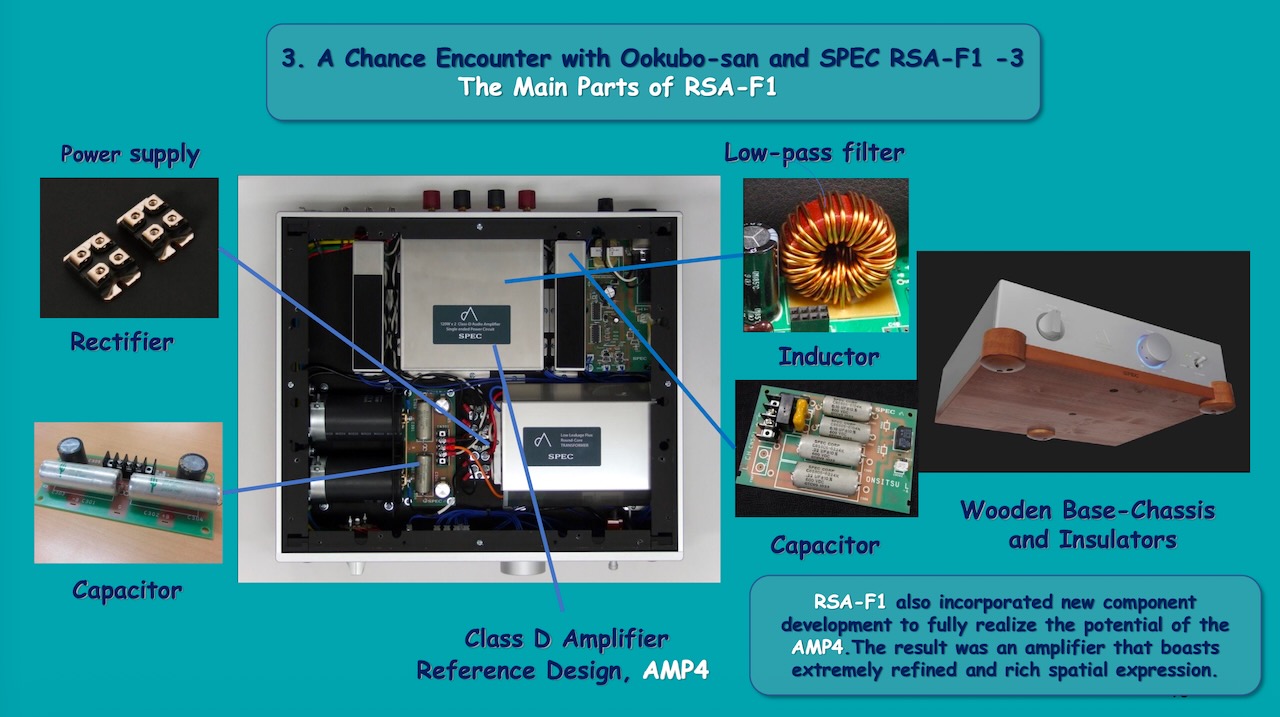
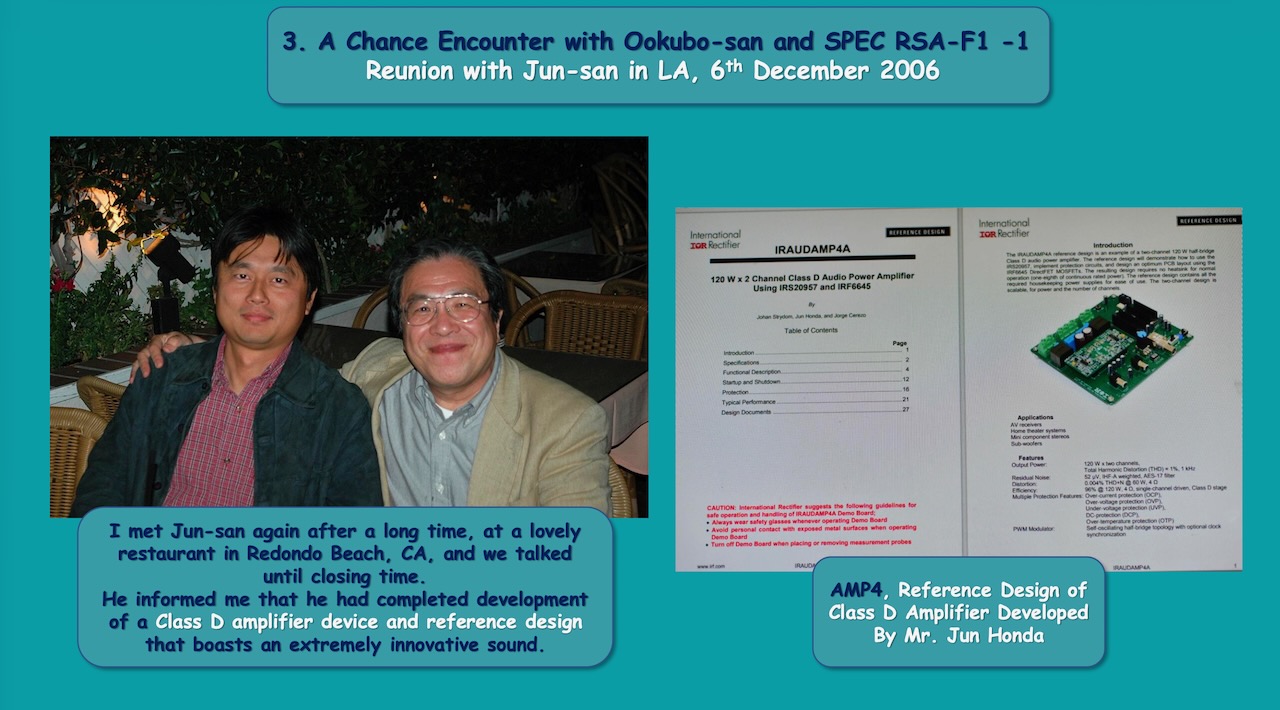
Well, I think the RSA-F1 was probably the first authentic and high-quality PWM Class D amplifier in the world and was really based on a splendid Class D reference design, which we called AMP4. The official name, IRAUDAMP4, was developed by my close and long friend Mr. Jun Honda, who is now the authority in the field of Class D design, in 2006, when he was working at International Rectifier in LA.
The first time I experienced the basic sound quality of the AMP4 was around February 2007, while I was still working at Pioneer. I built a simple linear power supply without any voltage regulator, 35V, and connected it to the AMP4, and it immediately worked well as a power amplifier.
The PWM Class D amplifier has obvious advantages in terms of its operating principle, comes with a fast and powerful attack, but I still vividly remember it easily driving the heavy 15-inch woofer of the B&W 801 that was set in the DVD development team's listening room.
Up until then, it had been difficult to reproduce such powerful and three-dimensional low frequencies with famous high-power usual Class A or AB semiconductor power amplifiers in the market. I also felt that the basic AMP4's rich and musical low-mid range sound was quite similar to the triode single-ended amplifiers I had been long familiar with.
In order to maximize the potential of the AMP4, the RSA-F1 adopted two Arizona Red Cactus capacitors and two mica capacitors connected in parallel in each channel of the low-pass filter that extracts analog audio signal output from the PWM waveform, minimizing resistance loss in the capacitors across the entire audible range.
As a result, the Red Cactus delivers beautiful, pure mid-to-high frequencies, while the excellent mica capacitors enable outstanding spatial expression at the highest frequencies. The RSA-F1 therefore boasted extremely high-quality and noble sound reproduction and was ideal for the string performance or the female vocal in particular.
Therefore, it was the perfect choice for Ookubo-san, who had a particular love for classical music. You will see the nice review of RSA-F33EX in High Fidelity in Poland below. F33EX was a small version-upgrade model, based on F1, mainly for the European market. High Fidelity

Please click on the link below to go to the next page.