
2. The Result of My Posting to Semarang / Indonesia and My Religious Eye Opening
Now, this chapter does not touch on the qualitative technical theories related to improving the sound quality of vacuum tube amplifiers, which I think many of the readers will be interested in. Sorry, but it is mainly about my religious beliefs, so I’d like you to feel free to skip this chapter.
Ookubo-san and I have one more thing in common. We are both Christians, and this was the origin of our meeting. In Western countries like Europe and America, such relationships would be completely normal and natural, but in Japan, the total number of Catholics and Protestants is said to be less than 1 million, meaning Christians make up less than 1% of the population.
Therefore, the opportunities for Christians, plus both audio enthusiasts, to get to know each other would be extremely rare. Of course, I sometimes pondered over whether my meeting with Ookubo-san was merely a coincidence or whether it was a fateful encounter guided by the Lord. However, when I reflect deeply on the reasons and circumstances that led me to become a Christian, I can only say that there was some great one guiding me there.
Well, the roots of Ookubo-san's faith can be traced back to his mother, who was a very devout Christian. And she often encouraged Setsuko-san to read the Bible to her grandchildren, rather than fairy tales, when raising them. In other words, he was a born-in Christian, something that is very rare in Japan. Also, Ookubo-san's appreciation of classical music was apparently inherited from his father. In short, the tough-looking Ookubo-san was a son of a good family in Japan at the time.
But in my case, it's completely different. On the contrary, I think that my existence and situation were quite ordinary for a Japanese person. Well, for better or worse, there would be a unique Japanese mentality with high ethical standards in general and a relatively sophisticated moral code, but I think modern Japan is a non-religious country. I have no way of knowing how Japan is viewed from other countries, but I understand that the atmosphere of ancient capitals, such as a lot of old temples and shrines in famous tourist cities like Kyoto and Nara, would be very appealing to foreigners as well.
However, I believe that Japan's traditional or ancient religions, such as Buddhism and Shinto, are no longer at the heart of our minds and souls, nor do they provide mental support in our real lives. But the educational level of Japan is generally high, so it is common for people to have some knowledge of the characteristics of each religion, and this was the case for me as well. Needless to say, there would be a huge gap between knowledge and faith, which could almost be called a disconnect. And perhaps it was also because I was an engineer for a long time who only believed in what I could see.
But the time when I had been a non-believer, was baptized, was at the peak of my professional career, while working away from home in Semarang, Indonesia, at the age of 54. I was in charge of the department manager of three engineering and development departments in five years, and had brought a variety of audio-visual equipment to the world. While there were difficulties in creating new value together with many young engineers, I also felt great joy, and so it was a time when I felt that "this may be my calling."
One thing I still recall with some honor is the fact that I was able to oversee the product development of the DV-AX10, the highest-end DVD player at the time it was released on the market at the end of 1999. The manager of the development and design team was Banno-san, who would later work with me on the development of Class D amplifiers at SPEC Corp. And it was an unusually large project, with over 40 engineers involved, including firmware engineers.
The DV-AX10 was designed to have not only the best possible image and picture quality as a DVD player, but in fact, I was aiming for the best possible sound quality as a CD player as well. Its sound quality design was handled by two young, up-and-coming engineers with excellent musical sense.
During my lunch break, I would hole myself up in the listening room with the two of them, listen to my favorite vocal CDs, and when the break was over, I used to tell them my impressions of the day. And the next, based on my feedback, the sound engineers would then try to further improve the sound quality.
As we continued this process, I came up with the idea of replacing the preamp in the listening system with my own Model 7 k for creating the best listening environment and truly it helped us to enable appropriate and accurate sound evaluation for more than a half year.
Fortunately, thanks to their efforts and dedications, the sound quality of the AX10 was very solid and massive, especially in the mid-low range, with a positive sound that projected forward, setting it apart from the generally safe and average sound of Pioneer’s previous products.
As a result, it received the highest level of praise from a lot of reviewers and all of the audio-video magazines in Japan, and for me personally, it has become a monumental product of my long professional career as an engineer.
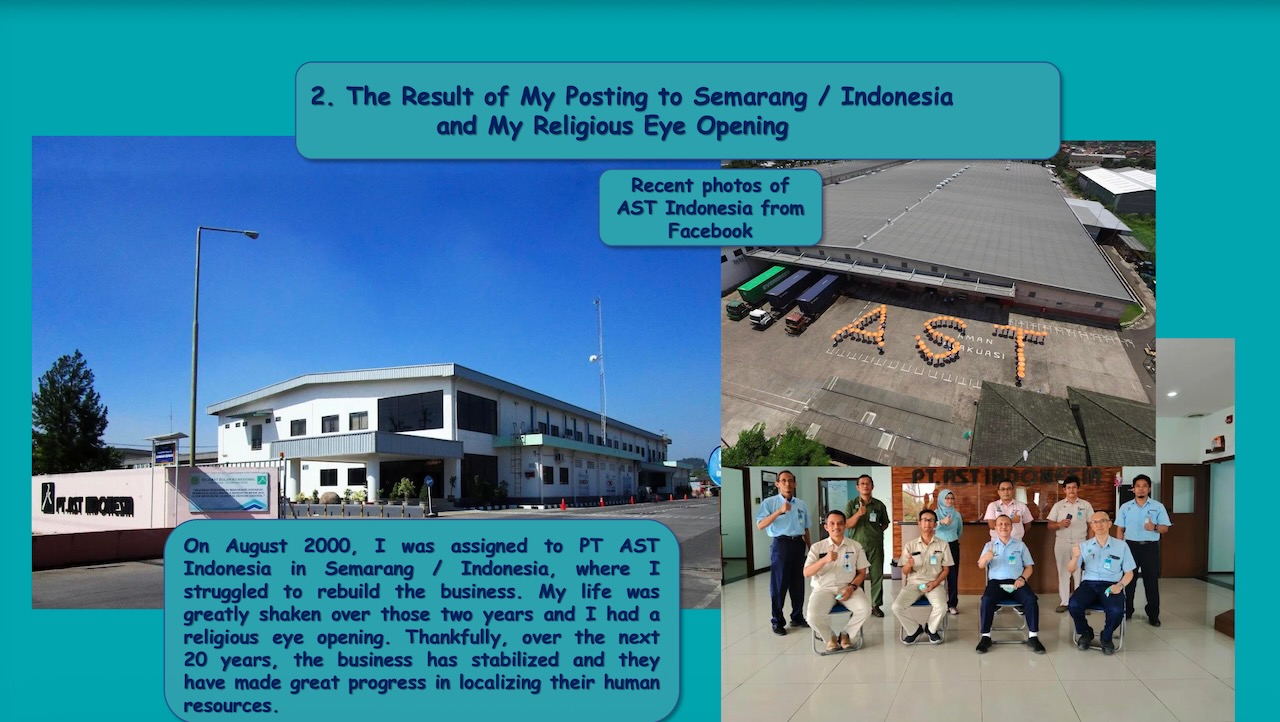
However, it was probably in May 2000, before market evaluations and sales figures for the DV-AX10 in overseas markets were fully available, that I was suddenly asked to be posted overseas. In Japan, the surprise of an unimaginable event is expressed as a bolt from the blue, and that is exactly what happened to me at that time.
Even so, it was at just the right time that I first learned of the existence of the subsidiary company called AST Indonesia in Semarang, Indonesia, that was proposed to me. And so, rather than being just an engineer, I was now being asked to take charge of the management of this subsidiary, with the responsibility of quickly turning it into a profitable business.
If I thought about it objectively, it was true that as an engineer, I was already over 50 years old and in terms of ability, it was no longer feasible to lead frontline development, and there may not have been any desirable next career path for me in the engineering department.
Given those objective circumstances and if I interpret it positively, I could have thought that the company had seen something in my potential and latent abilities and was creating a new career opportunity for me. But, at that moment, I felt an indescribable sense of expectation that I would be able to have new experiences in a completely unknown exotic land far away from Japan.
Please click on the link below to go to the next page.