



8. Alan-san’s Impression and Thoughts
For a little over a decade, I have had a wonderful time with life and my audio adventures with Yazaki-san. He has been an excellent and very patient mentor, and a great and wonderful close friend to me. I am very grateful! I have extreme and sincere gratitude to the Lord facilitating our meeting and to be able to have this continuing blessed time to share life's adventures with you, Yazaki-san!
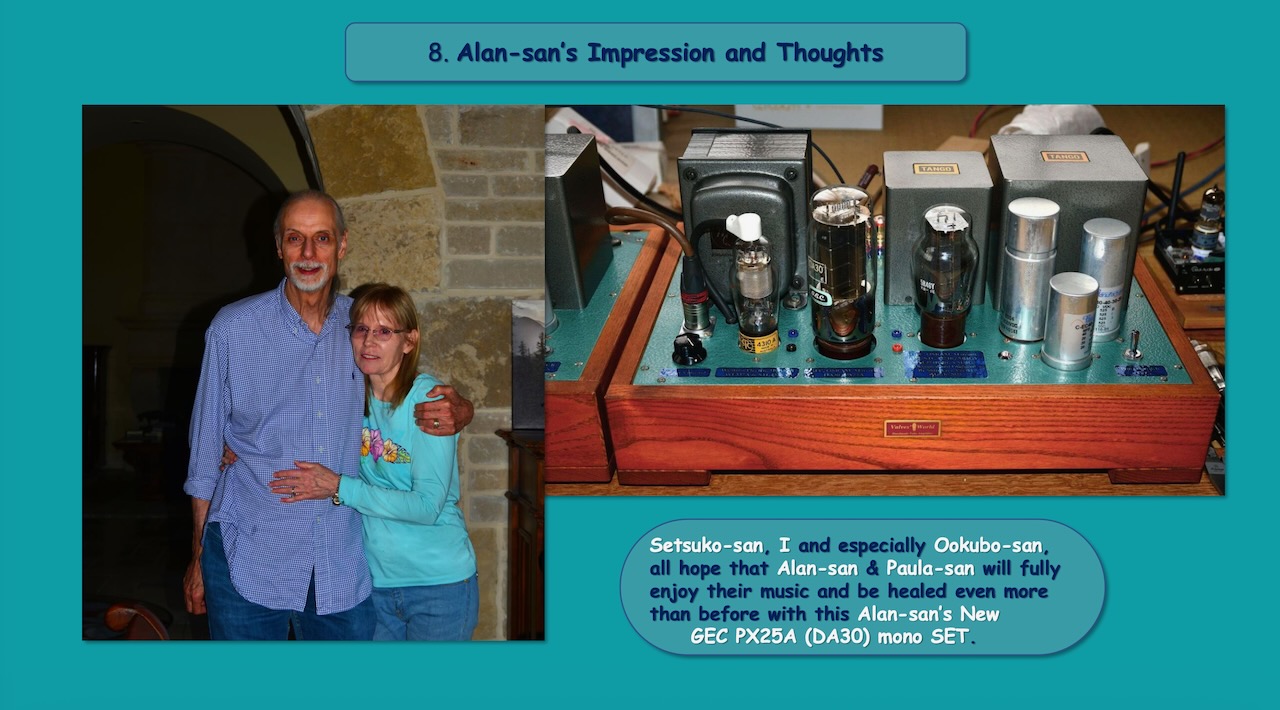
Last year we were able to be lucky and have a chance to find the Ookubo-san WE310A-PX25A(DA30) Mono SET amplifiers when they came up for purchase from the estate of Ookubo-san. Additionally, Yazaki-san was able to facilitate my obtaining part of Ookubo-san's collection of fabulous exotic tubes to enhance bringing out the magic of these Mono SET amplifiers that Yazaki-san built up for Ookubo-san many years ago. I am very grateful to Ookubo-san's widow and Yazaki-san for inviting me to experience and hold dear to my heart these excellent and Real-Sound producers.
It is simply a beautiful time when listening to and appreciating these WE310A-PX25A(DA30) Mono SET amplifiers. As mentioned in detail by Yazaki-san, there have been very careful, tedious, and thoughtful selections of the constituent parts that resulted in building up the musical texture and wholeness presented with these amplifiers. The notes seem to linger in a palpable sense of rightness and falling with the decay of energy as you would expect hearing in the room or hall of a real live event.
True to this journey of life, feeling real and right moving along the ebbing rise and fall of flowing compressions and rarefactions. I am time, and time again, having the feeling of sitting with the performance of the artists while lost in the moment of the musical surroundings while patiently and softly slipping out of the orientation of Chronos into the magical Kairos. These feelings are consistent whether listening to small, large, vocal, or specialized ensembles of Blues, Jazz, Orchestral, and Rock recordings. There is a simple ease of presentation that delivers a wholeness resonating with the performance at hand.
I must agree with the comments made by Nishikawa-san and Motoki-san. The sound of these Mono SET amplifiers exceeds what I have heard before and brings an uncanny realism to the reproduced music. The Yazaki-san WE310A-PX25A(DA30) Mono Set amplifiers are simply just right and make for the most beautiful presentation in clarity and tone.
Additionally, when one gets a chance, I invite you to have your own “Android Adventure” with the POCO X7 Pro into the humble tube-driven USB DAC, Douk Audio U4 connected directly via the Belden cable directly into your amplifiers. I believe it can be a wonderful experience for you. Maybe even find yourself a NOS RCA 5670 tube to start with and be prepared to be amazed. Thank you, my dearest friend and kindred spirit, Yazaki-san.
9. Memorandum
Regarding this amplifier, I’d like to write down a few things other than those mentioned in the main articles as a memorandum for myself.
First, I'd like to discuss the sound quality improvement effect of the Ultimate Ruby Mica 0.016µF /450 VDC. This upgrade added six URMs to each channel. First, to maximize the amount of information transmitted through the capacitors, I added them to the coupling capacitors and cathode bypass capacitors through which the signal current directly flows. Furthermore, to reduce the broadband noise level that extends into the high-frequency range of the plate power supply and DA30 heater power supply, I connected them in parallel with the main capacitors. I believe these efforts contribute to an effective expansion of the audible dynamic range.
Vintage directly heated rectifier tubes such as the WE274B, STC5R4GY (4274B), GEC, Marconi, and OSRAM U52 share a common thread: the wonderfully organic and universal sound, I’ve felt. However, each tube has its own unique and fascinating character. The WE274B evokes the culture and prosperity of America, which led the world in the 1940s and 1950s, while the STC5R4GY and U52 evoke cutting-edge British electronics and the elegant British atmosphere around the time during World War II. Human moods and emotions are fickle and may easily become bored. Also, your favorite music may also change over time. At times like these, replacing your rectifier tube can double the pure joy of listening to music and help you rediscover the joy of your deep audio hobby.
Unfortunately, until now, I had no idea about the origin and descent of the made-in-the-USA output transformer, with its large exposed core and overly rugged appearance. Of course, the excellent sound quality of the original Ookubo DA30 mono SET was the result of the large, directly heated triode, DA30, and the characteristics of this made-in-the-USA output transformer. All I understood was that this made-in-the-USA output transformer had slightly lower loss and a more powerful, expansive sound than also large, high-quality Japanese output transformers I had used in the past, such as the TANGO FW50-5S, TANGO FX50-5S, and HASHIMOTO H-30-5S.
However, just recently, I came across these single-ended output transformers in an online advertisement HERE. The external shape and size were an exact match. The manufacturer was Hammond, and the model number appears to be P-T1628SEA. If so, the price of USD 227.20 perunit seems like a nice bargain.
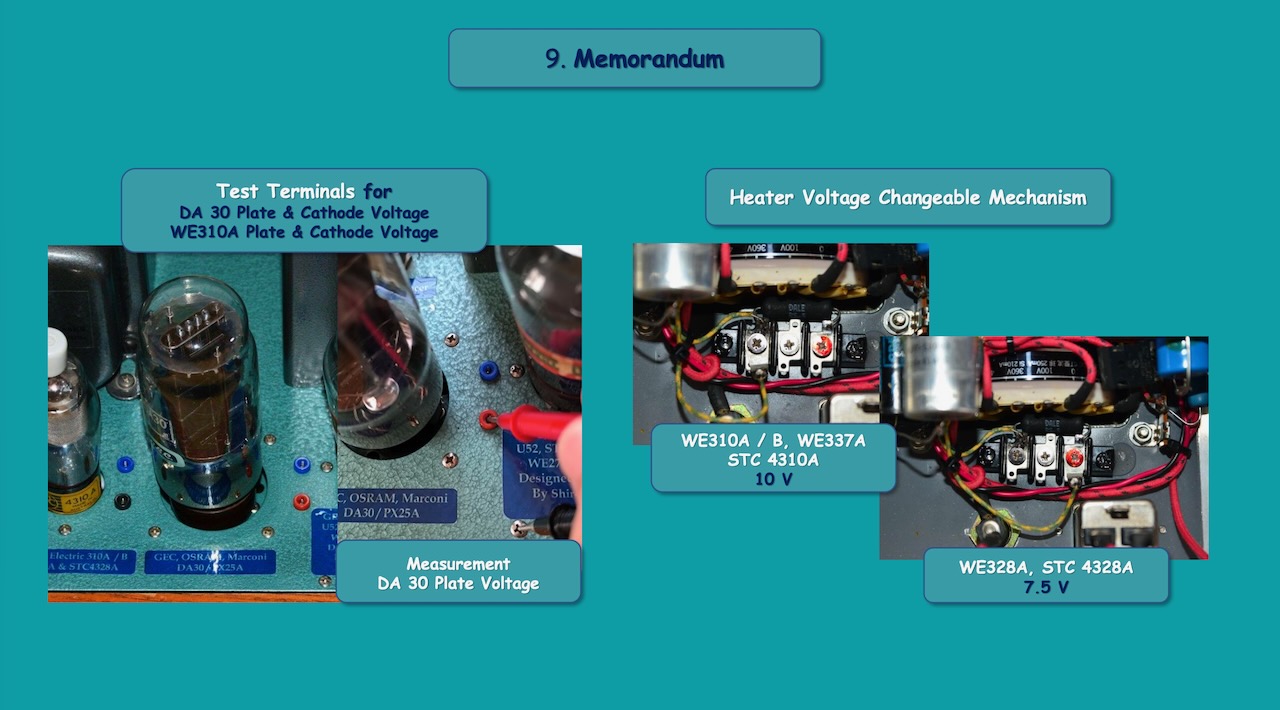
Now, since this amplifier is self-biasing, no adjustments are required when replacing power tubes. However, it is necessary to perform a health check on the important tubes or to determine whether they are good or bad. This amplifier has test terminals on the top panel that allow us to easily check the plate voltage and cathode voltage of the driver and power tubes.
One option is to monitor the output tube's cathode current with a meter, but this would insert unnecessary resistance into the signal circuit, which would have a negative effect on sound quality. These test terminals are extremely effective for checking the important cathode current of the driver and power tubes. Furthermore, when replacing rectifier tubes, by inserting known tubes into the driver and power sockets and then reading the power tube's plate voltage, we can determine the quality of the rectifier tube while the amplifier is in operation.
The heater voltage of the WE310A / B is 10V, but there is also the WE328A, which has the exact same specifications but operates at 7.5V. Since Alan-san already owned the WE328A mesh and STC 4328A mesh, both rare tubes, this heater voltage changeable mechanism was added as a final step. By simply adding a 6-ohm resistor to the 10V tap output of the power transformer, the heater output can be reduced by almost 2.5V.
Now, regarding the physical characteristics of the capacitor attached to the slides, please note that these are measurements made with my simple LCR meter. Also, while the characteristics of electrolytic capacitors are temperature-dependent, therefore these are not precise measurements as they were not always taken at the same room temperature. But I have found through a lot of experiences for more than 10 years that the measured ESR (equivalent series resistance) values closely match the audible results.
In particular, the larger the electrolytic capacitor, the more the impedance curve tends to switch from capacitance to inductance toward the lower frequencies. While the ESR value will certainly be low in the low frequencies, the value in the mid- and high frequencies will likely be poor.
So, in a typical Class A or Class AB solid-state amplifier, when extra-large electrolytic capacitors are installed on both sides of a large power transformer, there might be poor power supply response in the mid- and high frequencies, and so the sound would tend to be dull and uninteresting.
Epilogue
Now I ask myself: Would I have completed the DA30 mono set just for myself, with such attention to detail and lavish craftsmanship? The answer is no. I would never have been able to devote so much effort, both financially and time-wise, to completing this amplifier. Of course, there might have been a lot of compromises along the way. It was only with the support of Ookubo-san, a rare hobbyist, and his deep understanding and trust in my abilities, aspirations, and personality, that I was able to do my best to fulfill his wishes.
Also, I have built a close friendship with Alan-san, the new owner of this DA30 mono set with dramatically improved sound quality, over the past 10 years. Alan-san is a truly humble yet passionate enthusiast with his keen eye and ear for the real thing, and I can only believe that my fateful encounter with him was guided by the Lord.
I'm convinced that what kept me going as I had continued this relatively difficult modification work was my dear friend Alan-san's high expectations for the completion of “Real-Sound”, and at the same time my growing desire to live up to his trust in me. In other words, if I hadn't been blessed with two such understanding people as Ookubo-san and Alan-san, I wouldn't have been able to see even the horizon in my long pursuit of “Real-Sound”, if there was a goal far beyond it. In that sense, I cannot express in words how grateful I am to you both.
I would also like to express my heartfelt respect and gratitude to Jeff-san for allowing me to publish this entirely personal, almost autobiographical essay, Part 7, on this global Jeff's Place.
If there's anything I can offer Jeff-san and all Jeff's Place readers around the world, I believe it's concrete methods for improving the sound quality and musicality of tube amplifiers, described in this Part 7.
Single-ended tube amplifiers in particular have very simple configurations and only a few parts, so I think the improvements made by replacing or adding parts could be clearly noticeable.
I sincerely hope that your tube amplifiers will produce a fun, soothing, and natural sound, and even more, will play music not only with the sound.
It's understandable that it's becoming increasingly difficult to obtain older, high-quality NOS parts. If you contact me directly, I may be able to help you in some way. My address is here; [email protected]
In any case, I'd like to express my sincere gratitude for reading this long article to the end. Thank you very much!
Many thanks to Yazaki-san and Alan-san for sharing their splendid article! Wishing you both - and all of you reading this - a fantastic 2026!
As always, thanks for stopping by, and may the tone be with you!