
6-3. Selecting the Cathode Resistor
When refining the sound quality of a vacuum tube amplifier, the cathode resistor, into which the signal current flows directly, is a very important element. In some cases, it could be said that of the many resistors used, this cathode resistor has the greatest impact on sound quality. When refining the sound quality of a tube amplifier, the cathode resistor, through which the signal current flows directly, is an extremely important element.
There is no way to qualitatively or quantitatively judge the quality of a resistor, like there is with the E.S.R. value of a capacitor. For this reason, the only way to judge the sound quality or sound character of each resistor is to actually install it in an amplifier and judge it for yourself by actual listening.
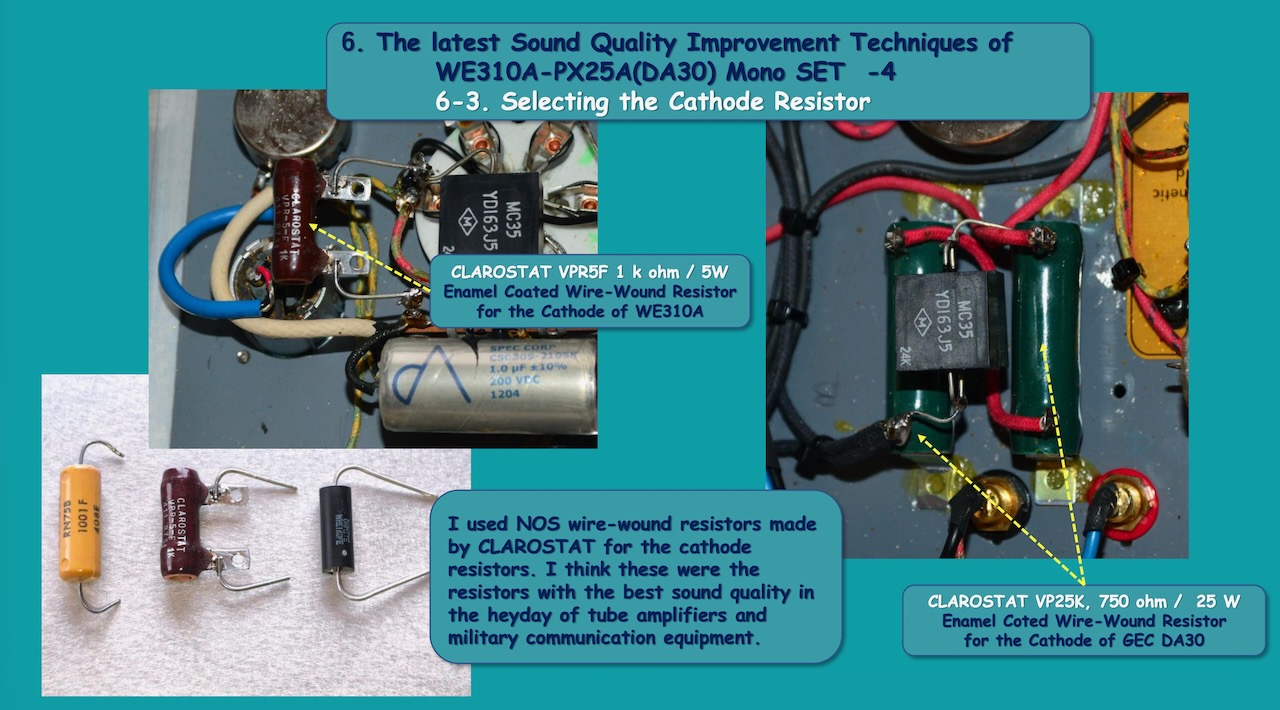
However, empirically, we can determine what type of resistor we should use depending on the required resistance value and current value. Well, the cathode resistance of the WE310A is set to 1 k ohm, while that of the PX25A (DA30) is a relatively low 1.5 k ohm. Considering these lower values, it follows that the most primitive type of resistors, wire-wound resistors, are desirable for sound quality.
Of course, that doesn't mean that just any wire-wound resistor will do. There are big differences in sound quality even between manufacturers, and personally I prefer the sound quality of OHMITE's wire-wound resistors. Also, while OHMITE's wire-wound resistors seem to share basic tonal characteristics such as a lively and bright tone, you can't help but notice subtle differences in sound quality between silicone-coated and enamel-coated wire-wound resistors.
For example, even within the same 5W model, there is a clear difference in sound between the silicone-coated 45 series and the enamel-coated 25 series or 200 series Brown Devil®. The 45 series has a rich mid-low range, and I feel that it has sound quality befitting typical vacuum tube amplifiers.
On the other hand, enamel-coated resistors have a smooth tone character in the mid-high frequency range and are free of roughness. For this reason, I prefer to use the most primitive enamel-coated type resistors in various places.
Well, non-inductive types are also available for 5W-class wire-wound resistors. Of OHMITE's 5W types, I rate the WHD type as having the best sound quality with the flat energy balance throughout the entire frequency range, but there is also a non-inductive type called the WHE type, which looks exactly the same.
Non-inductive types are not completely free of the inductance component unique to wire-wound resistors; rather, I think the qualitative understanding is that the directionality of the magnetic flux generated by this inductor cancels out the magnetic flux. However, it feels like this complex winding structure gives the sound quality a slightly harsh tone in the highest range.
This time, with these understandings, I replaced the cathode resistors with the ones below to improve sound quality. Through the cathode resistor of the DA30 output tube, the current, about 70 mA, flows directly and steadily. And the applied cathode voltage is about 100 VDC. This means that the cathode resistor consumes a large amount of power, 7 W. As a result, the only option for this resistor that can withstand such higher power consumption is a durable power resistor with enamel coating.
In fact, the original configuration prioritized long-term reliability by dispersing the heat source and included a series connection of 50 W 1 K ohm and 500 m ohm OHMITE 89 series metal-clad resistors sealed in an aluminum heatsink.
However, by some luck, I found a CLAROSTAT VP25K, 25 W class enamel-coated resistor at a store I regularly frequent and specialize in old NOS parts. The green enamel color was so beautiful, and I immediately knew it would probably produce a good sound, so I replaced it in this mono SET by connecting two 750 ohm resistors in series. This was because I only expected the smooth, natural sound of the enamel-coated resistors.
For the cathode resistor of the driver tube, WE310A, which is the most sensitive element that affects sound quality, I prepared three different types of resistors for my hearing comparison. One was a NOS high-capacity, 2W metal-film resistor, SPRAGUE RN75, 1 k ohm; another was a NOS CLAROSTAT VPR5F 1 k ohm enamel-coated resistor; and the third was an OHMITE WHD, a resistor I have complete confidence in for its excellent sound quality as I described before.
The SPRAGUE RN75 is almost impossible to obtain these days, but I regard it as having the highest sound quality among metal film resistors. I was particularly impressed by its excellent sound, especially the surprisingly low noise level, when used with the 82K ohm NF resistor in the Model 7 tone amplifier.
Therefore, I wanted to actually try it out to see what kind of sound would be produced when used with this cathode resistor. Perhaps due to its low noise level, the sound quality was simply exquisite, and I was amazed at how clear the details were, almost visible to the naked eye. I listened to it for about three days, and my initial impression remained the same, but I began to feel a bit tired, as if I was being forced to concentrate on the details of the music, or as if I was peering at a miniature painting for a long period of time.
Next, I replaced the resistors with CLAROSTAT VPR5F, 1 k ohm. The moment I just heard the first music, I realized that these resistors had achieved my goal. The noise level is in no way inferior to that of the best metal-film resistor, SPRAGUE RN75.
However, perhaps because of the rich mid-low range, there were no sound quality elements that irritated me. I only believed I’d reached a point where simply continuing to listen to music was both relaxing and enjoyable. And so, since the results were more than satisfactory, I decided not to try to replace it with OHMITE WHD. Perhaps by coincidence, the resistors related to the cathode, this CLAROSTAT VPR5F, that CLAROSTAT VP25K, and as well as the hum balancer directly connected to the cathode, CLROSTAT 10 ohm / 4W wire-wound VR, have all been unified into the resistors by CLROSTAT Mfg. Co., Inc.
Please click on the link below to go to the next page.