



Greetings friends, I hope you are well. 🙂
The title of this post includes part of a comment made by friend Yazaki-san to me about a new amplifier technology developed by Jun Honda at Infineon. The full comment is:
"I believe Infineon's GaN Class D technology will likely be regarded by future generations
as a landmark development in the century-long history of amplifiers."
That comment got my attention, as Yazaki-san knows breakthrough amplifier performance when he hears it, and this is the start of a story I want to tell you about this topic in a series of installments here at Jeff's Place in the coming months.
I started hearing little encouraging whispers of intriguing information about ongoing research with GaN Class D technology developed by Jun-san at Infineon some months ago. Then things went quiet for a while.
Then more news arrived in the last week, exciting information that I can now share with you.
Let me start with a report by Yazaki-san of a the demonstration of Infineon's GaN Class D amplifier devices at the “OTOTEN 2026” in Tokyo, which is one of Japan's largest and most prestigious audio events.
Without further ado, here's Yazaki-san's report from the festival.

"Today, I would like to share with you a brief update regarding Jun-san’s recent visit to Japan. Fortunately, an event called "OTOTEN 26" - one of Japan's largest audio festivals - was held last week (the 19th through the 21st) at the Tokyo International Forum, a very modern venue."
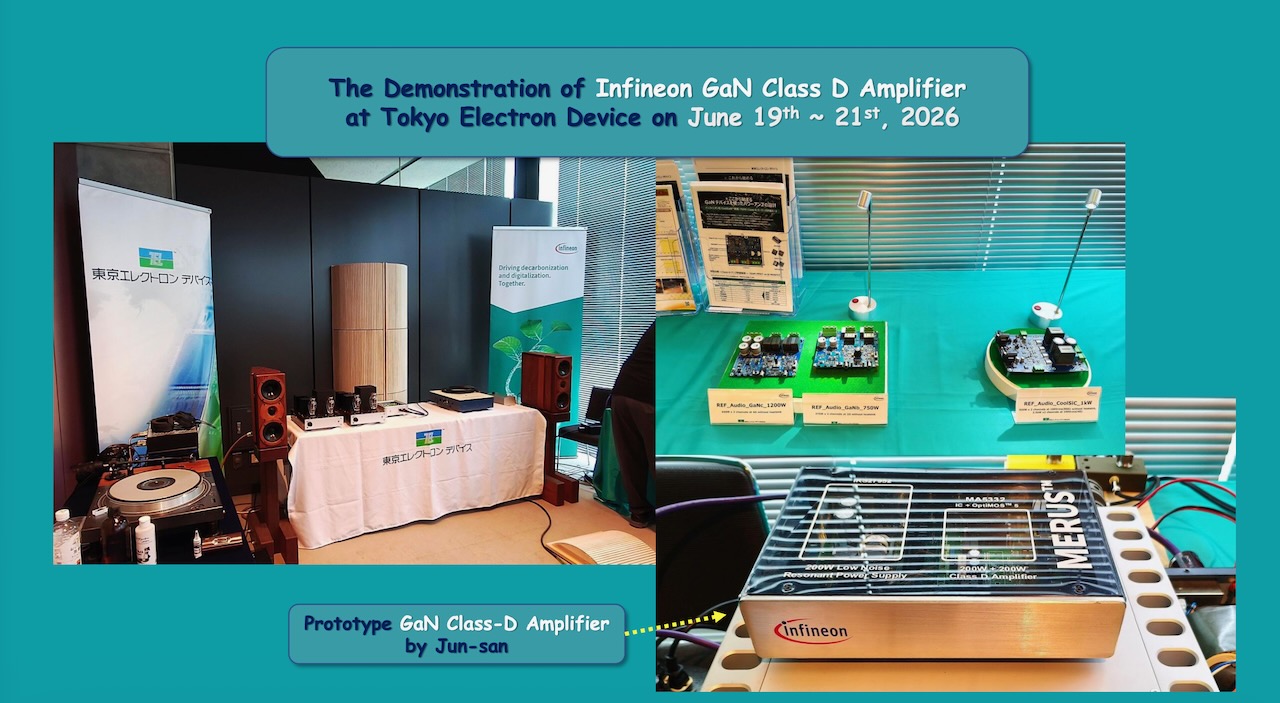
"In collaboration with Tokyo Electron Device, Infineon’s domestic distributor, various demonstrations featuring GaN (gallium nitride) Class D amplifiers were conducted over the three-day period, and Jun-san himself participated as part of the operations team."
"Personally, I had lost interest in these types of audio shows - which have essentially turned into exhibitions for High-End audio equipment from various manufacturers or importers - and had stopped attending them recently."
"However, knowing that Jun-san was visiting Japan, I was very fortunate to have the opportunity to see his work firsthand and talk with him about it. As a result, I enjoyed all three sessions held in the Tokyo Electron listening room on the first day (the 19th) and fully appreciated the program on the final day (the 21st) from 10:00 AM to noon."
"Of course, experiencing Infineon’s GaN Class D technology was also one of my primary objectives. In any case, unlike the demonstrations of new audio products typically seen at events like "OTOTEN," the presentation regarding this new core technology was certainly highly unusual; as Jun-san pointed out, it seems this would not have been possible without the enthusiasm of the distributor, Tokyo Electron Device."
"And the program consisted of three sessions. The first featured Mr. Shibazaki—an old acquaintance and long-time technical commentator for MJ magazine—introducing the technical characteristics of the GaN device through a dialogue with Honda-san. Let me recount a portion of that discussion here."
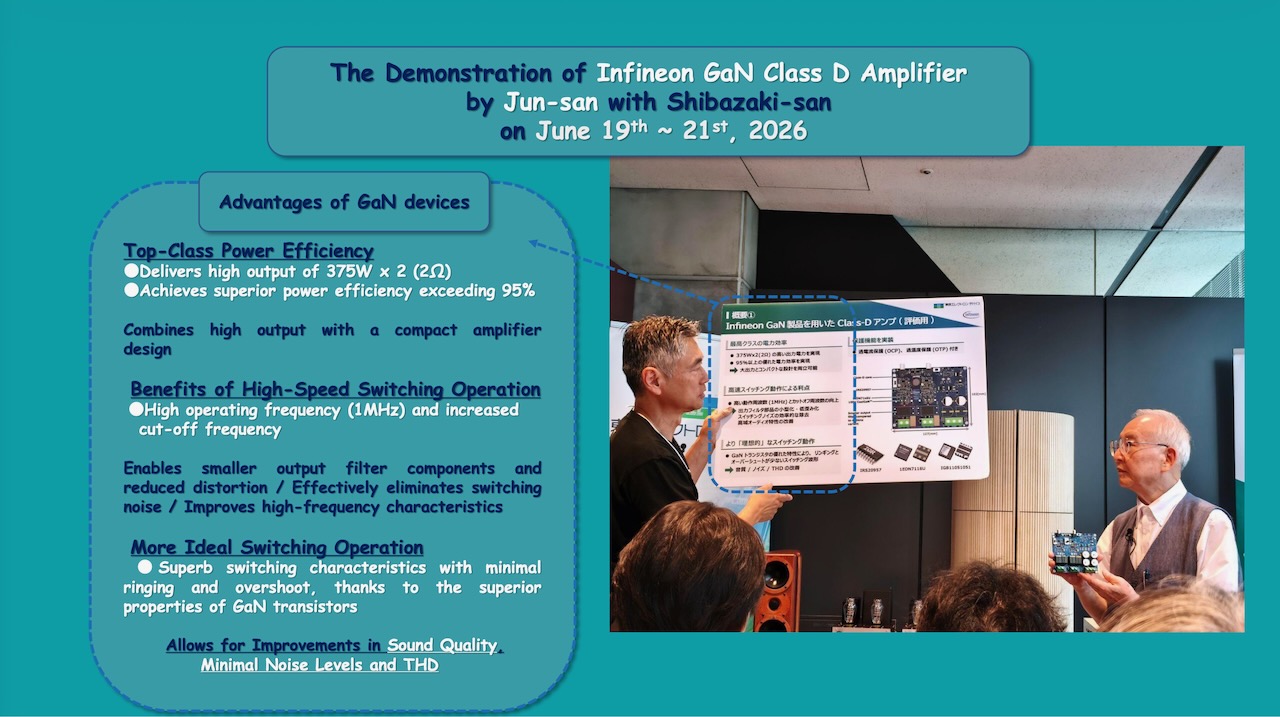
“Jun-san: With standard silicon-based devices, the basic principle involves using a gate to attract electrons to the area beneath it—essentially turning the device "on" by creating a conductive path for those electrons. In other words, you start with a device that is normally "off" and switch it "on" by using the gate to gather electrons. GaN devices, on the other hand, are fundamentally different because they are naturally in an "on" state. This happens because layering gallium nitride and aluminum gallium nitride triggers an effect called piezoelectric polarization, causing electrons to automatically accumulate at the interface between the two materials. This creates what is known as a two-dimensional electron gas layer; by attaching electrodes to both ends, you get a device that is fully "on.""
"Shibazaki-san: We can certainly look forward to some exciting results."
"Jun-san: Exactly. Since there are no obstacles, electron flow is extremely smooth. Furthermore, because GaN has a very high electric field strength, the device can be made incredibly small while enabling high-speed switching."
"Shibazaki-san: And because there is less loss, that’s what made a switching frequency of 1 MHz possible, correct?"
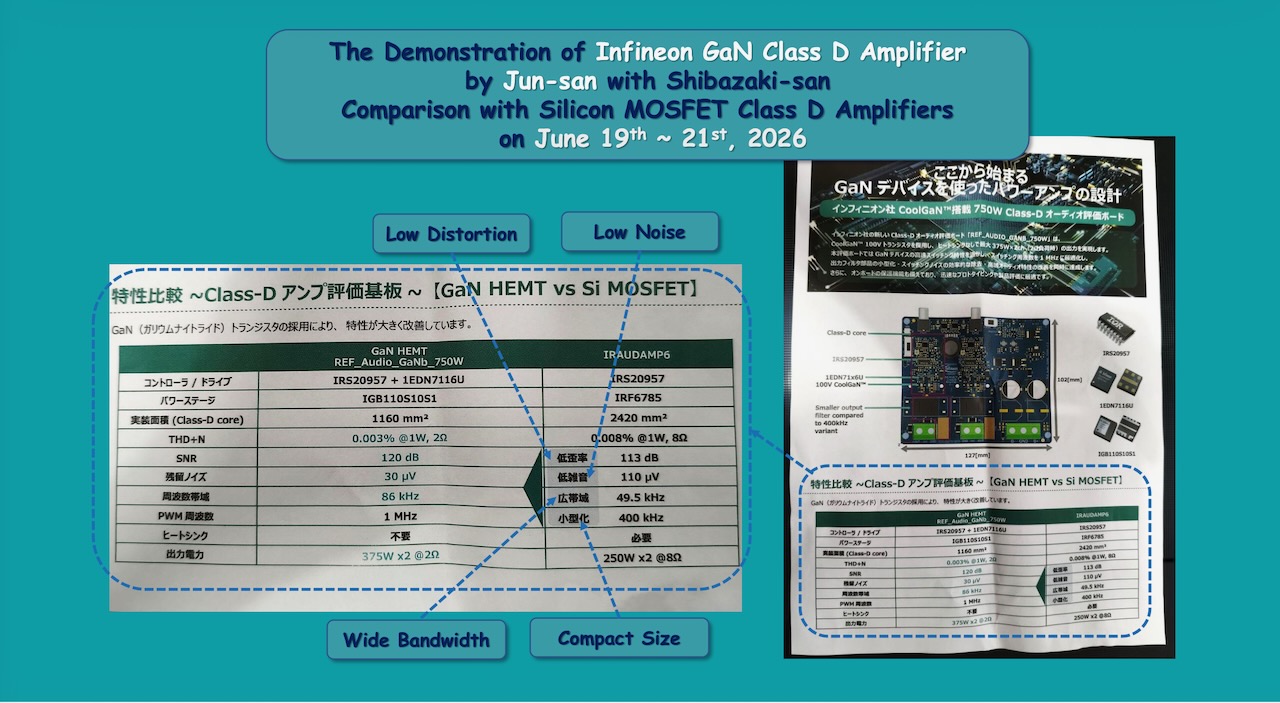
Yazaki-san: "In short, my understanding is that Infineon's GaN devices feature a structure completely different from conventional silicon-based semiconductors; they are "normally on" devices that allow electrons to travel at high speeds without obstruction. And furthermore, they offer extremely low on-resistance and enable high-speed switching, while virtually eliminating the ringing and overshoot in PWM waveforms that are critical for Class D amplifiers.
"Furthermore, the PWM frequency of Class D amplifiers using GaN devices has reached the high level of 1 MHz, extending the audio amplifier's frequency bandwidth to 100 kHz."
"Effectively, this means that absolutely no traces of PWM modulation remain in GaN Class D audio amplifier's output within the audible range, resulting in a pure analog current for driving speakers."
"Another crucial advantage of the GaN Class-D amplifier—one that cannot be overlooked—stems from its extremely low ON-resistance; this allows the back-electromotive force (back-EMF) generated by the speaker itself to be regenerated back into the power supply."
"This means that the amplifier is inherently immune to a specific problem common in Class A and AB designs: the injection of harmful back-EMF into the essential feedback circuitry. In those conventional designs, such feedback causes unnecessary fluctuations in the phase axis of the signal circuit, thereby hindering realistic music reproduction and the accurate rendering of the soundstage."
"Following that discussion, they conducted a comparative listening test using a conventional silicon-based Class D amplifier and a state-of-the-art GaN Class D amplifier, both built by Jun-san. The music sources consisted of several CDs selected by Shibasaki-san, making for a rather safe and conventional listening session."
"However, one unfortunate thing was that the loudspeakers used in the demonstration had a small-diameter woofer and a soft-dome tweeter, a small baffle area, and low sensitivity. The loudspeakers produced a sound that lacked density in both the low and high frequencies, causing the mid-range to stand out disproportionately."
"However, even under such adverse conditions, the difference between conventional silicon-based Class D amplifiers and the GaN Class D amplifier in question was distinct; I felt that the expansive, rich soundstage - complete with a sense of atmosphere - was a major advantage of this GaN Class D amplifier."
"Later, I spoke with Shibasaki-san personally, and I heard his honest opinion: "Wow, this is amazing technology!"
"Well, I would also like to report on the third session, as I was impressed by how well-planned the program was. That session featured Tezuka-san, a relatively new, young writer of MJ magazine known for his DIY vacuum tube amplifiers."
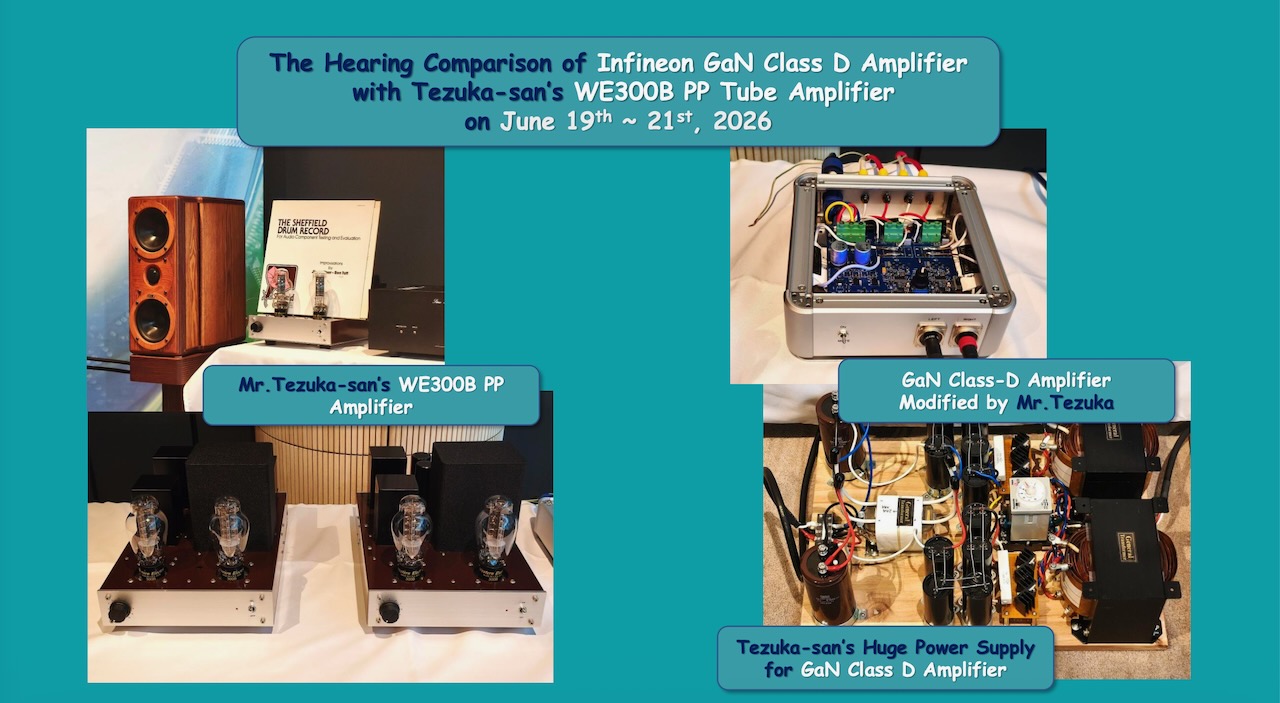
"He brought along two units: a Western Electric 300B push-pull amplifier featuring a highly unique FET-driven, transformer-coupled design, and a GaN Class D amplifier that he had modified by himself."
"While one was indeed a tube amplifier, the prospect of hearing the sound of a genuine Western Electric 300B PP setup—complete with large output transformers—was enticing. Furthermore, seeing the potential of a state-of-the-art GaN Class D amplifier in an audio context sparked the interest of many enthusiastic attendees, and I must admit, my own curiosity as well."
"Furthermore, the GaN amplifier unit-built Tezuka-san had undergone modifications designed to further enhance the final sound quality. Specifically, the low-pass filter for the Infineon Class D circuit board utilized an experimental FINEMET-Core inductor made by winding thick wire just a few times. In addition, the prototype power supply unit—so massive that it had to be placed directly on the floor—boasted an overwhelming scale that bordered on the excessive."
"Regarding the difference in sound quality, my honest impression after listening in that environment was simply that both were superb. However, with the WE300B push-pull amplifier (delivering an output of approximately 15W), distortion became noticeable once the volume exceeded a certain level, as the system was paired with low-efficiency speakers. Even so, the WE300B delivered that signature Western Electric sound; its captivating, organic tonal quality—particularly across the low-to-mid frequency ranges—was something that simply could not be ignored. On the other hand, the GaN Class D amplifier modified by Tezuka-san was completely free of distortion, delivering a powerful sound that was flat and balanced across the entire frequency spectrum. As for Tezuka-san’s own candid reflections, he mentioned in his demonstration, whenever he listens to music lately, he finds himself instinctively turning on this GaN amplifier."
"It struck me that a program like this was perhaps the most fitting event for a true audio festival. And it must have been a really meaningful experience for the many young engineers from various audio manufacturers in Japan - who learned of Jun-san’s visit to Japan - to join the audience in the Tokyo Electron Device listening room and witness such a rare and valuable session."
"I was also deeply impressed by the dedication of Manager, Mochizuki-san and the entire Tokyo Electron Device’s staff, who sincerely supported Honda-san in preparing for and conducting such a wonderful program. In short, the demonstration was a resounding success."
Yazaki-san and Jun-san
Yazaki-san:
"Jun-san and I once had a Junior-Senior relationship at Pioneer. There was an 18-year age gap between us, a difference that would normally make a close friendship unlikely. Yet, we have shared a common bond: a pure desire to enjoy good music with even better sound quality."
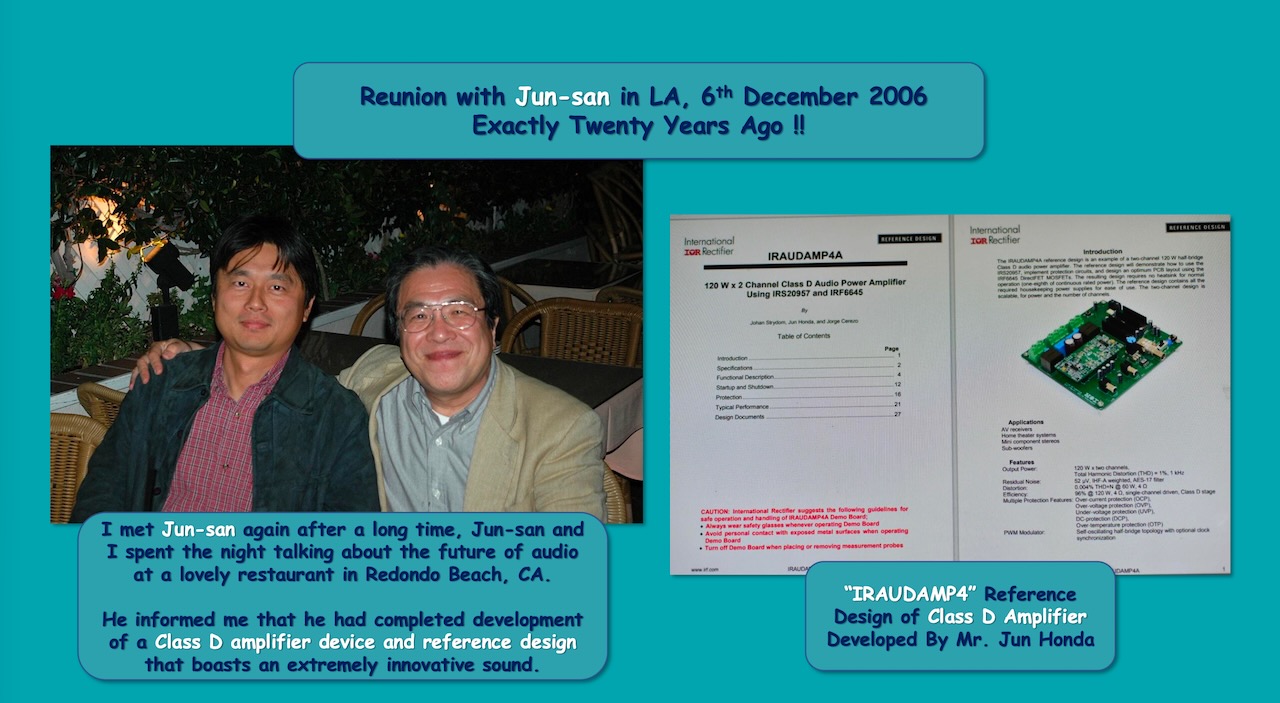
"In 2001, while I was struggling to turn around a manufacturing company in Semarang, Indonesia, I received a call from Jun-san. He told me he was moving to Los Angeles with his family to join International Rectifier. One day in 2001, while I was struggling to turn around the manufacturing company in Semarang, I received a call from Jun-san. He told me he was moving to Los Angeles with his family to join International Rectifier. As I faced the daily challenges of living in a foreign land, I could only wish him the best in his passionate pursuit of developing devices for Class D amplifiers."
"Five years later, in December, I reunited with him during a business trip to Los Angeles and learned that the development of the "IRAUDAMP4" - an outstanding Class D amplifier reference design realized through his dedicated efforts - had been completed. As for myself, I remained involved with the IRAUDAMP4 for over a decade starting in early 2007, pouring my passion into refining it at SPEC Corporation into a product that fully realized its potential."
"The successful market launch of the "Arizona Red/Blue/Green Cactus" hermetic- sealed capacitors and the revival of mica capacitors were all made possible thanks to that initial encounter with the “IRAUDAMP4”."
"Now, twenty years after the development of the IRAUDAMP4, Jun-san has achieved groundbreaking success by expanding the application of GaN power devices—developed at Infineon—into the audio sector. As a developer, Jun-san has built his career with truly remarkable tenacity over these past twenty years. Furthermore, his journey as an engineer was blessed by the fortunate emergence of "GaN"—a new type of power device born from the demands of modern society."
"When I reunited with Jun-san at OTOTEN, I found him to be not only a supremely talented engineer, but also a man of genuine maturity and character, capable of engaging warmly and openly with those around him. He embodied the ethical values - such as the respect for propriety found in Bushido - and the sense of humility that were once considered essential traits of the Japanese spirit."
"I could not help but feel profound respect for a talented young friend like Jun-san, who continued to refine his character even as he has navigated the hardships of his professional journey. I am simply deeply grateful to have maintained such a long-standing relationship with Jun-san."
Thank you Yazaki-san for your report, that's very exciting news indeed.
But wait, there's more. Here's a link to MJ magazine's report about the demonstration sessions that you can read as well (HERE).
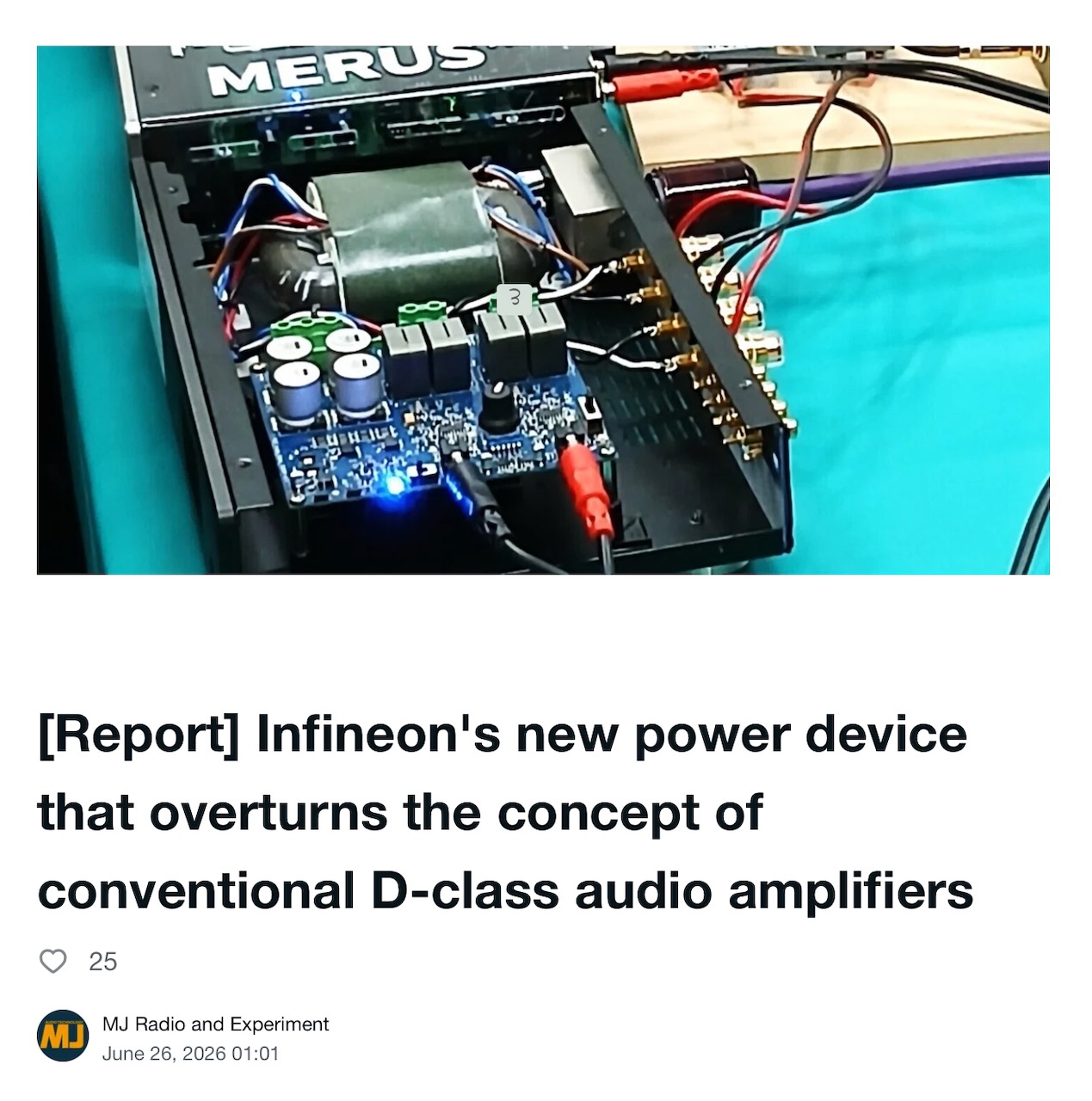
If you use the Safari browser you can choose to translate the Japanese text into English.
It's a fascinating report, so be sure to read through it.
Oh wait, there's even more! After Jun-san returned home, he sent me the following email:
Dear Jeff-san,
I am back from my trip and still trying to adjust to local time.
The GaN-based class D amplifier was incredibly well received by the audiophile community in Japan - unexpectedly well I must say. Knowing that this amplifier is just an evaluation board with no audio-grade components, I did not expect the sound quality to be good enough for the OTOTEN show.
The demo unit is currently still on tour. Once it is returned, I would love to get your firsthand impression of it, if you don't mind listening to a plain evaluation board with a standard switched mode power supply. I will also have a modified audiophile-grade version later this year, if you would prefer to test a product-like demo unit. Please let me know your thoughts.
Best regards,
Jun
I was excited to read the email from Jun-san, and I'm happy to say that I'll be bringing more news to you about this exciting amplification development in the not too distant future.
I proposed to Jun-san that I would like to listen to both the demo unit of the plain evaluation board with a standard switched mode power supply that he demonstrated at OTOTEN 2026, as well as the modified audiophile-grade version when that becomes available.
I would like to say a big "Thank you!" to Yazaki-san and Jun-san for allowing me to be a part of this developing amplification adventure, and I consider it a true privilege to tell you all about it!
Stay tuned for more about this developing story!
As always, thanks for stopping by, and may the tone be with you!