
As is my custom, I like to give you a "sneak peek" into my upcoming Positive Feedback review articles, which in this case is about the limited edition Acoustic Revive Analog Stabilizer PS-DBLP. Enjoy!
The full review has now been published at Positive Feedback and you can read it HERE.
Greetings friends, I hope you are well.
I’ve always been impressed with Mr. Ken Ishiguro’s approach to audio. Ken-san builds insightful audio products with innovative applications of technology that always make a positive contribution to the sound quality and musicality of my audio systems.
I’ve been writing about Ken-san’s audio creations for almost twenty years now, and they never disappoint. You can see the full list of articles I’ve written about Acoustic Revive products HERE. Scroll down to where you see “The Acoustic Revive Chronicles” for links to all the articles.
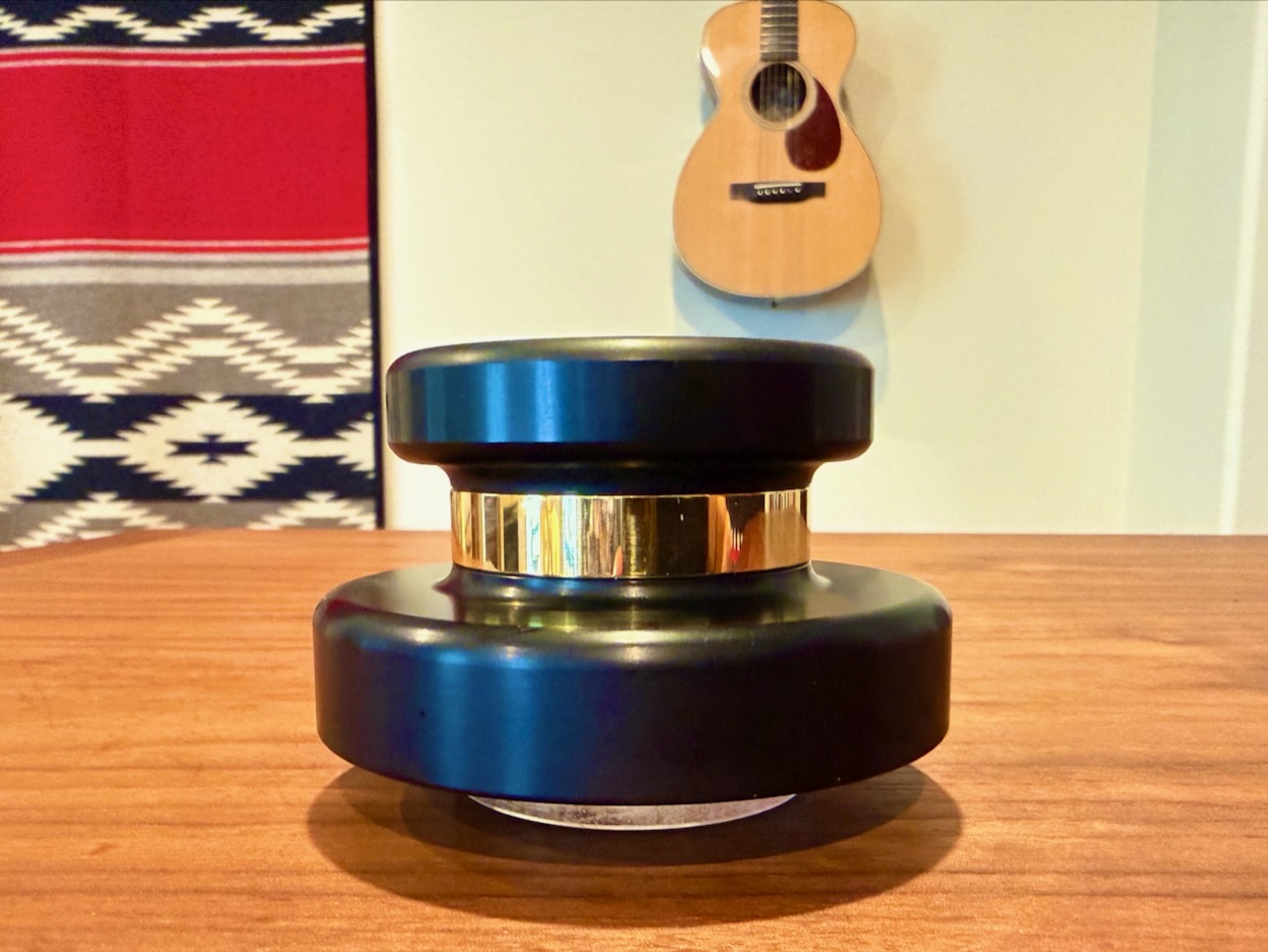
The subject of today’s article is the Acoustic Revive Analog Stabilizer PS-DBLP.
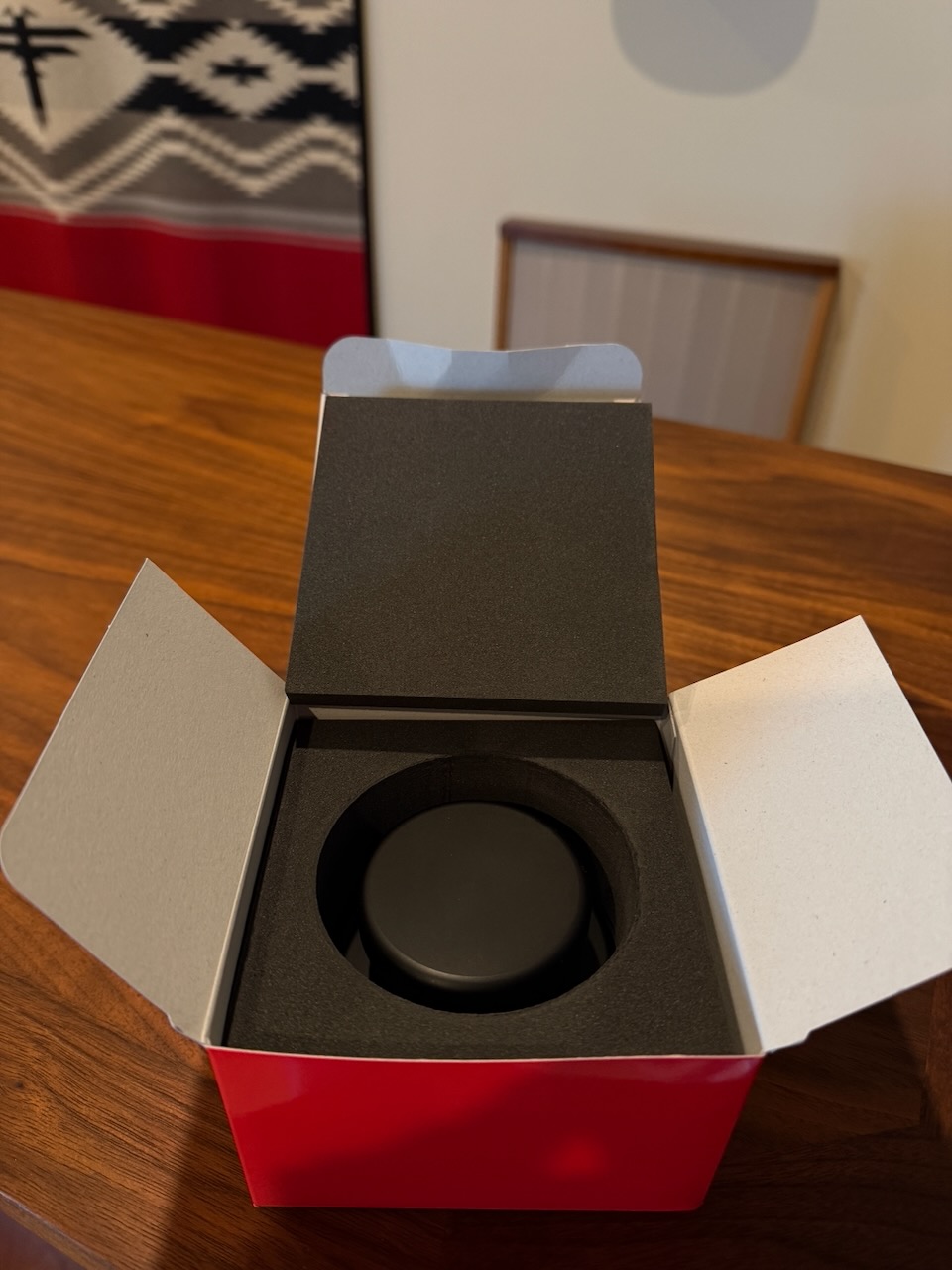
Like all of Ken-san's creations, the fit and finish are extraordinary. As a nice touch, the analog stabilizer PS-DBLP comes safely packed in protective, form-fitting packing material to make sure it gets to you in pristine condition.
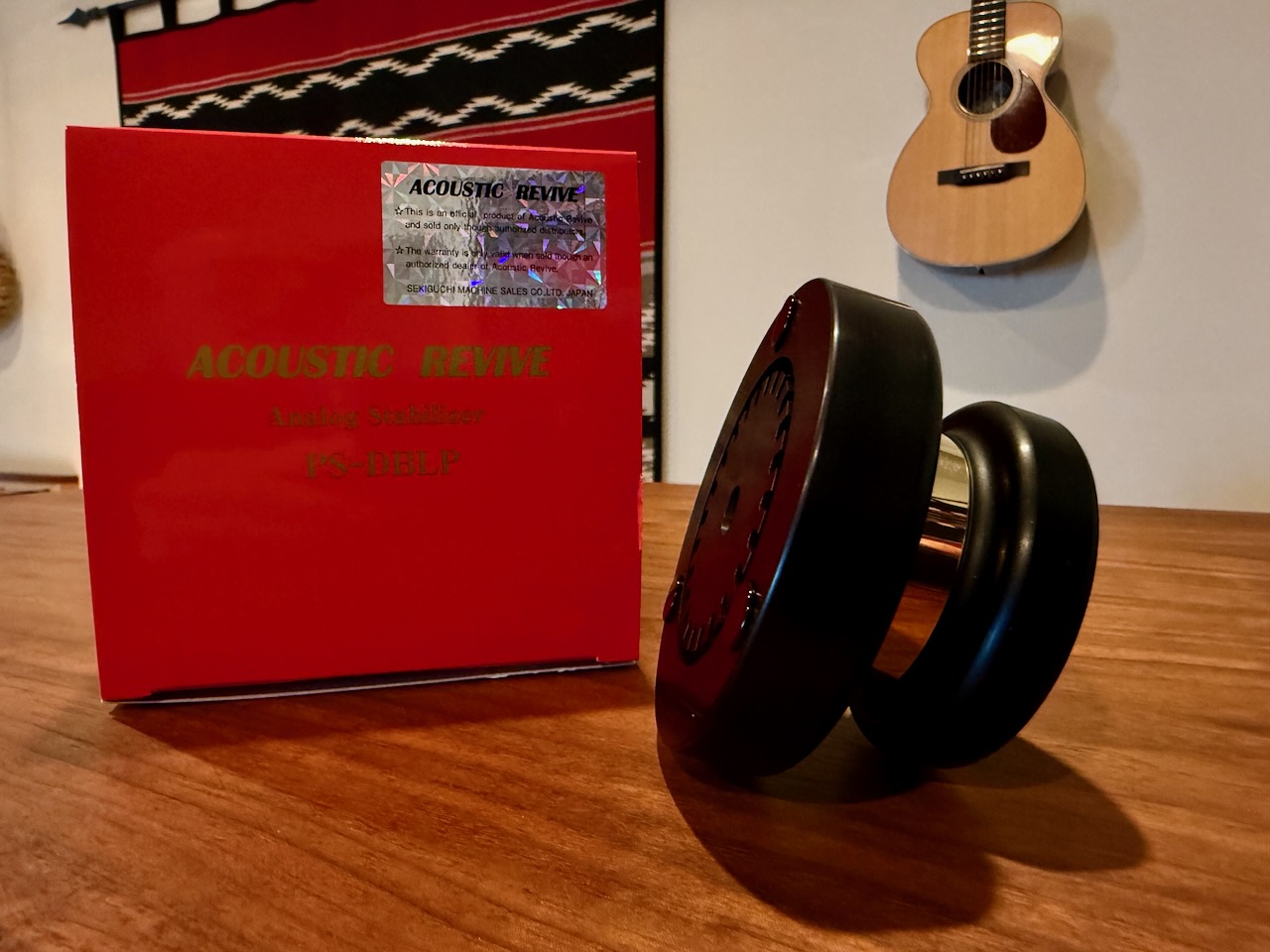
All of Ken-san's creations have more to them than classy looks, though, as they are carefully thought out in terms of design and materials science to provide the intended benefits to the listener.
"Intended benefits? It's just a record weight, right? It just holds my record down on the mat.”
It turns out that “record weights” have evolved from being devices that just mass-load a record to hold it securely in place, and into active devices that do much more than that.
So you’ve probably surmised that the idea of the PS-DBLP is that it does more than just squash your LP down securely onto the record mat.
Ken-san's idea is that a record weight can be designed through materials science principles to actively reduce or eliminate vibrations from the two primary vibrational pathways present in a turntable: acoustic and structural vibrations.
Structural vibration comes from the mechanical operation of the turntable (e.g. the turntable motor, platter rotation, etc.), and acoustic vibration comes from the loudspeakers - the music - impinging on the record and turntable’s surface.
Essentially, all you want is the "good vibrations” from the stylus tracing the groove going into the moving-coil in the cartridge to be converted to an electrical signal, and not those "bad vibes” from the turntable motor and loudspeakers added to it which degrade the signal’s sound quality.
Here's what Ken-san says about the PS-DBLP:
"PS-DBLP combines super duralumin and brass heterogeneous metals, and has a groove with a geometric pattern that effectively suppresses vibration, and places a natural smoky quartz resonator that supports the point on the contact surface with the record label, and in the interior a large number of natural ore particle blends are enclosed in a groundbreaking structure that instantly converts vibrations generated from motors and speakers from analog players and disappears. You can experience the overwhelming sound quality improvement effect, such as clear sound image positioning that is three-dimensional and dynamic, which overturns the concept of analog stabilizers that only added the tone of the material."
Ken-san doesn't divulge exactly how his PS-DBLP design works, design secrets and all, but based on other products Ken-san has designed and I have written about, I think I may have a pretty good idea - so let me speculate a bit on how the PS-DBLP might work to reduce vibration.
All high-mass record weights will have some vibration damping effect on a turntable due to mass loading. By adding mass to a vibrating system, the mass loading damps vibrational energy by reducing its oscillation amplitude and energy. A good thing.
So it is a given that the PS-DBLP damps vibrational energy present at the record’s surface by mass loading. Typically, the optimum mass for a record weight is considered to be in the range of 375 grams to 460 grams. The higher the mass, the more vibration is damped. The PS-DBLP weighs in at about 460 grams.
Now let’s take a look at the vibrational characteristics of common materials used for record weights, as well as the uncommon materials used in the PS-DBLP.
While mass damps vibration, the composition of the mass also affects its ability to damp vibration. So if a selection of record weights have the same mass, but are made from different materials, they will have differing abilities to damp vibrations, and will sound different as a result.
Aluminum has conductive vibrational properties that can amplify vibrations, so generally speaking, aluminum is to be avoided where vibration reduction is desired, as in audio applications.
Duralumin (A2017) is an alloy of aluminum, copper, and magnesium. Duralumin is heavier than aluminum due to copper increasing its density, and giving it a higher strength-to-weight ratio, which makes Duralumin a popular choice for aerospace applications. Duralumin’s mechanical properties and internal friction mechanisms enable it to absorb and dissipate vibrational energy more effectively than aluminum. This enhanced vibrational damping characteristic makes it suitable for applications that need vibration reduction.
Super Duralumin refers to a type of aluminum alloy (A2024) which is strengthened with higher amounts of copper and magnesium compared to standard Duralumin. Super Duralumin exhibits improved vibrational damping characteristics due to its higher copper content, which enhances its mechanical properties and internal friction mechanisms, resulting in better damping characteristics and lower vibration amplitudes compared to standard duralumin.
Brass has moderate damping properties, which effectively reduces unwanted vibrations in electronic devices. Consequently, it’s frequently employed in connectors and housings to minimize noise and interference.
Quartz’s vibrational characteristics are high stability, low loss, and effective vibration control, which makes it a popular choice for oscillators and sensors.
Tourmaline possesses unique piezoelectric properties that enable it to enhance vibrational energy harvesting by converting it into heat. This makes it a valuable material for sensors and other electronic applications where reducing vibration is desirable.
So each of those dissimilar materials has a different effect on vibration transmission and control, and given that the PS-DBLP is constructed of layers of quartz, Super Duralumin, brass, and perhaps tourmaline, those layers of dissimilar materials affect how vibration travels through the PS-DBLP to be dissipated.
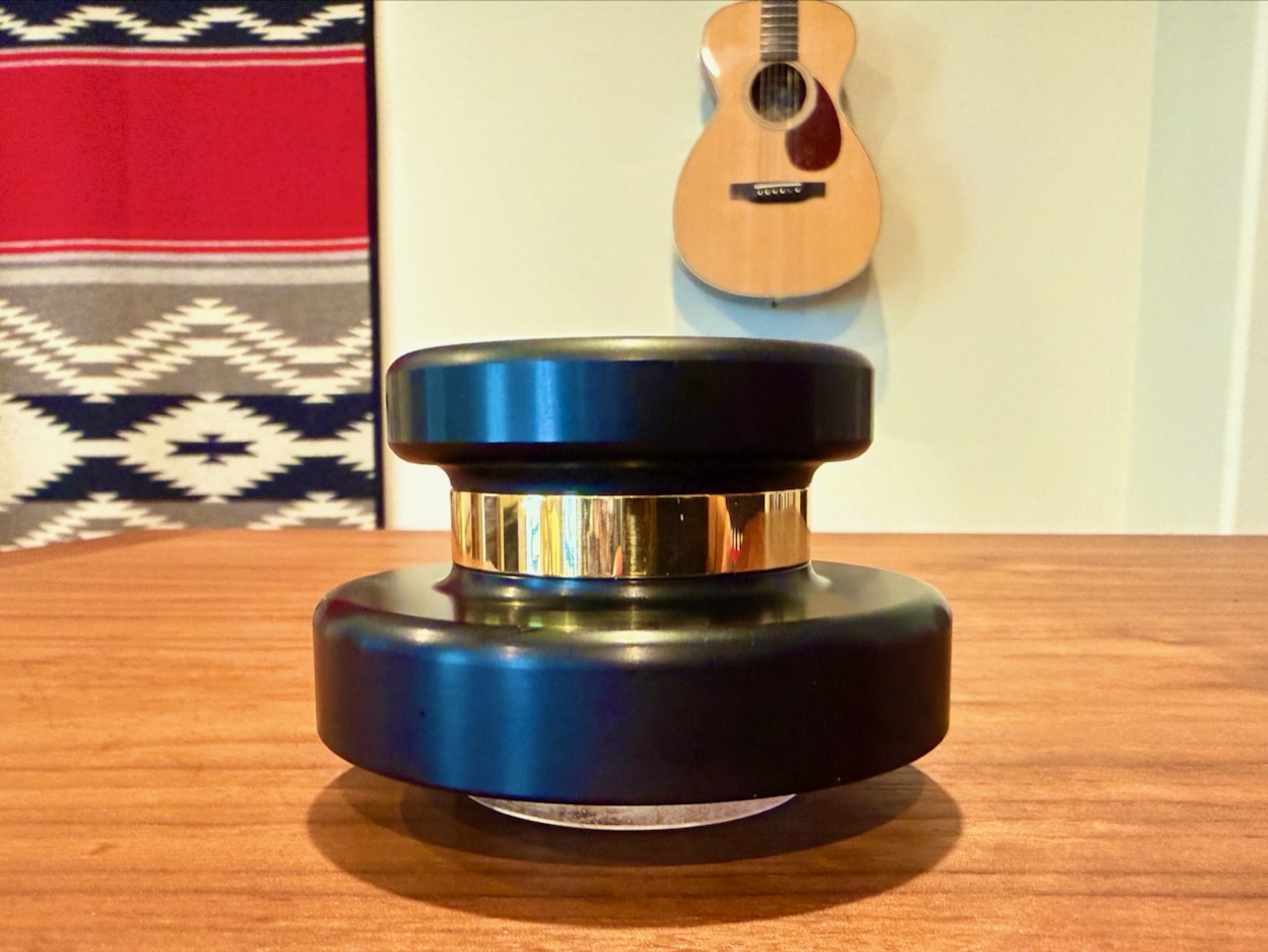
If you look at the side view of the PS-DBLP (above), you can see the Super Duralumin (black anodized CNC'd pieces on top and bottom), with brass in the middle. There are also three quartz resonator discs on the bottom surface of the PS-DBLP which you can’t see in the photo, and - I suspect - tourmaline crystals in the interior structure of the PS-DBLP, which you also can’t see in the photo.
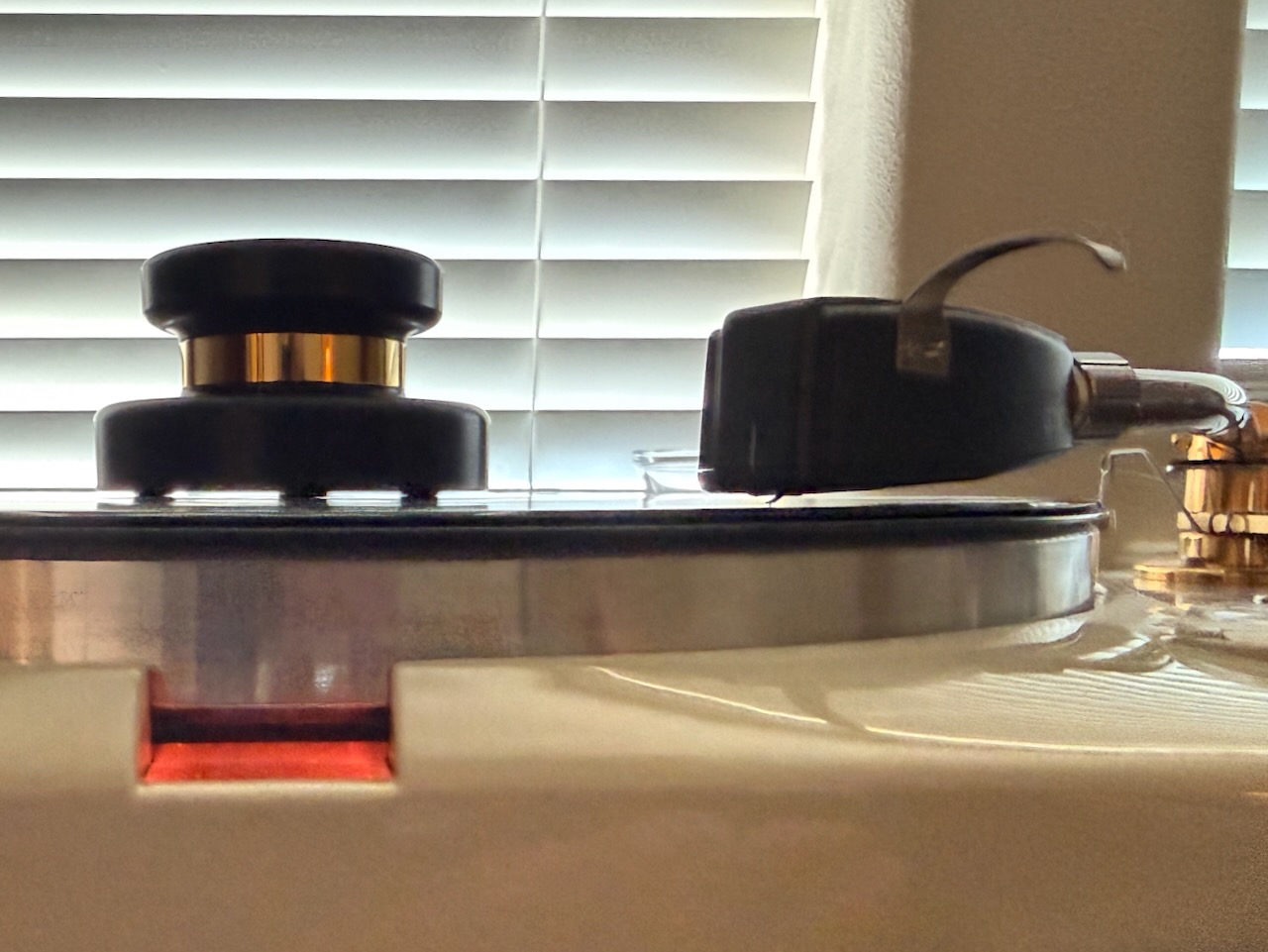
If you look closely at the photo above, you can see how the three quartz resonator discs contact the surface of the record label, and how they elevate the PS-DBLP slightly above the surface of the record.
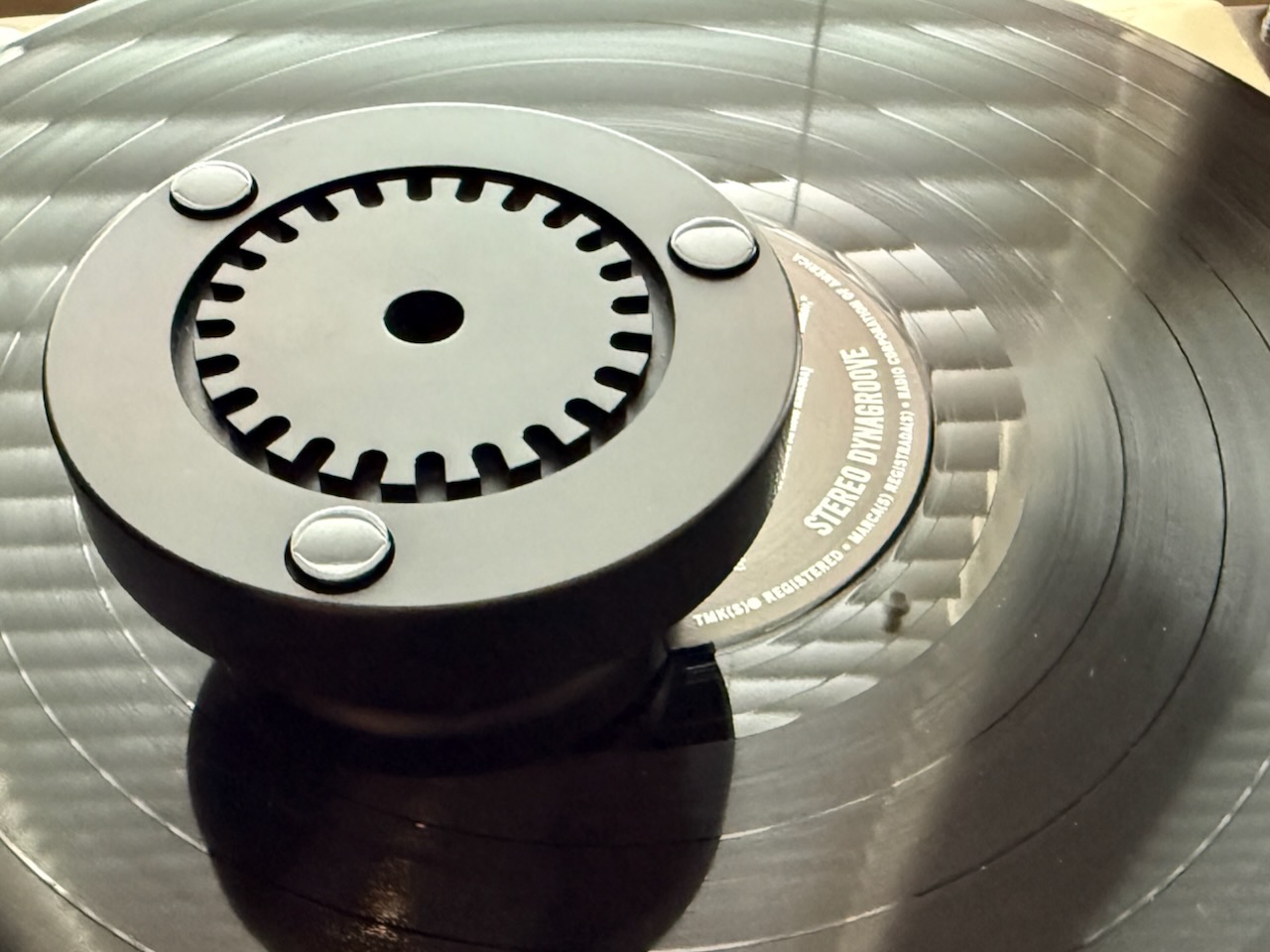
If you look at the bottom view of the PS-DBLP (above), you can see how the three quartz resonator disks are mounted to its outer perimeter. Those round disks are the "natural smoky quartz resonators" Ken-san mentions that are the point-of-contact on the record's surface.
The idea is that the quartz resonators mitigates and transmits surface vibrations into the PS-DBLP's interior. Also, note the geometric pattern that is machined into the bottom of the PS-DBLP that Ken-san says "effectively suppresses vibration."
Inside the PS-DBLP: Ken-san says, "... in the interior a large number of natural ore particle blends are enclosed in a groundbreaking structure that instantly converts vibrations generated from motors and speakers from analog players and disappears."
In other components Ken-san produces, he uses tourmaline crystals for their unique properties of converting vibrational energy into heat, so I suspect that is also the case for the PS-DBLP.
Here's an AI explanation for the way tourmaline works: "Tourmaline is a unique piezoelectric and pyroelectric mineral that converts mechanical stress, vibrations, and temperature fluctuations into electrical energy. This, in turn, generates negative ions and far-infrared (FIR) radiation, which are absorbed by surroundings as heat. This "resonance absorption" allows tourmaline to effectively turn physical vibrations into heat."
Then there are the three quartz crystal resonators located on the bottom of the PS-DBLP that rest upon the record label’s surface: quartz crystals are widely used in wristwatches, telecommunications, and medical devices for timing and frequency control due to their ability to vibrate at specific frequencies due to their piezoelectric properties.
Quartz crystals respond to both mechanical stress / mass loading and vibrational energy with a piezoelectric effect. If I understand it correctly, the pattern machined in the base of the PS-DBLP helps dissipate vibrational energy coming from the quartz crystals into the base, and from the internal tourmaline crystals that convert vibrational energy into heat.
The turntable spindle can act as a conduit for vibrational energy from the motor, and when the PS-DBLP is placed over the spindle, the vibrational energy from the motor is absorbed by the tourmaline and converted to heat.
Okay, so that’s my understanding of how the Acoustic Revive Analog Stabilizer PS-DBLP works.
Audio System for This Article
My audio system for this article consisted of the following:
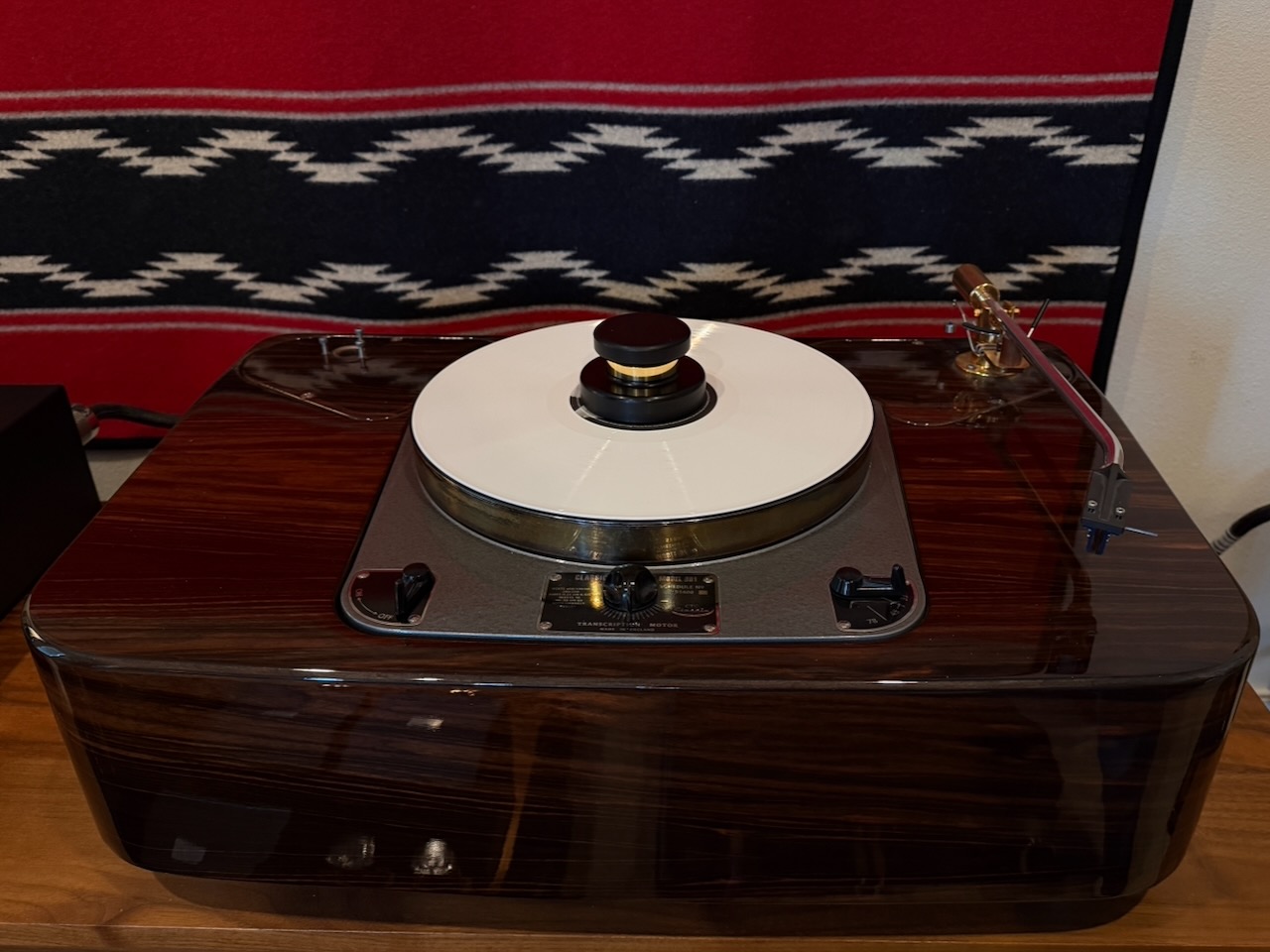
My turntable is Classic Turntable Company Classic 301 motor assembly equipped with an oversize high-mass (12kg) brass platter, mounted in a high-mass Artisan Fidelity plinth fitted with Stillpoints Ultra SS footers.
I use a SPEC AP-UD1 Analog Disc Sheet (turntable mat) on the brass platter, a Thomas Schick 12-inch tonearm - rewired with silver wire - is mounted on the plinth’s armboard, and a Thomas Schick graphite headshell equipped with Acoustic Revive hybrid silver-copper PC-TripleC/EX headshell leads rounds out connections to the phonograph cartridge.
An absolutely dreamy and über-performing combination of Audio Note (UK) components are visiting me at the moment: the Io I moving-coil phonograph cartridge, AN-S8 step-up transformer, and M8 RIAA phono equalizer provide the analog signal to drive a drool-worthy Ongaku 211 SET integrated amplifier.
The Ongaku powers my Tannoy Westminster Royal SE loudspeakers that are hot-rodded with ultra-performing custom Duelund CAST silver & copper crossovers (Part 1, Part 2, Part 3).
The Ongaku and M8 RIAA phono equalizer rest upon Acoustic Revive isolation platforms.
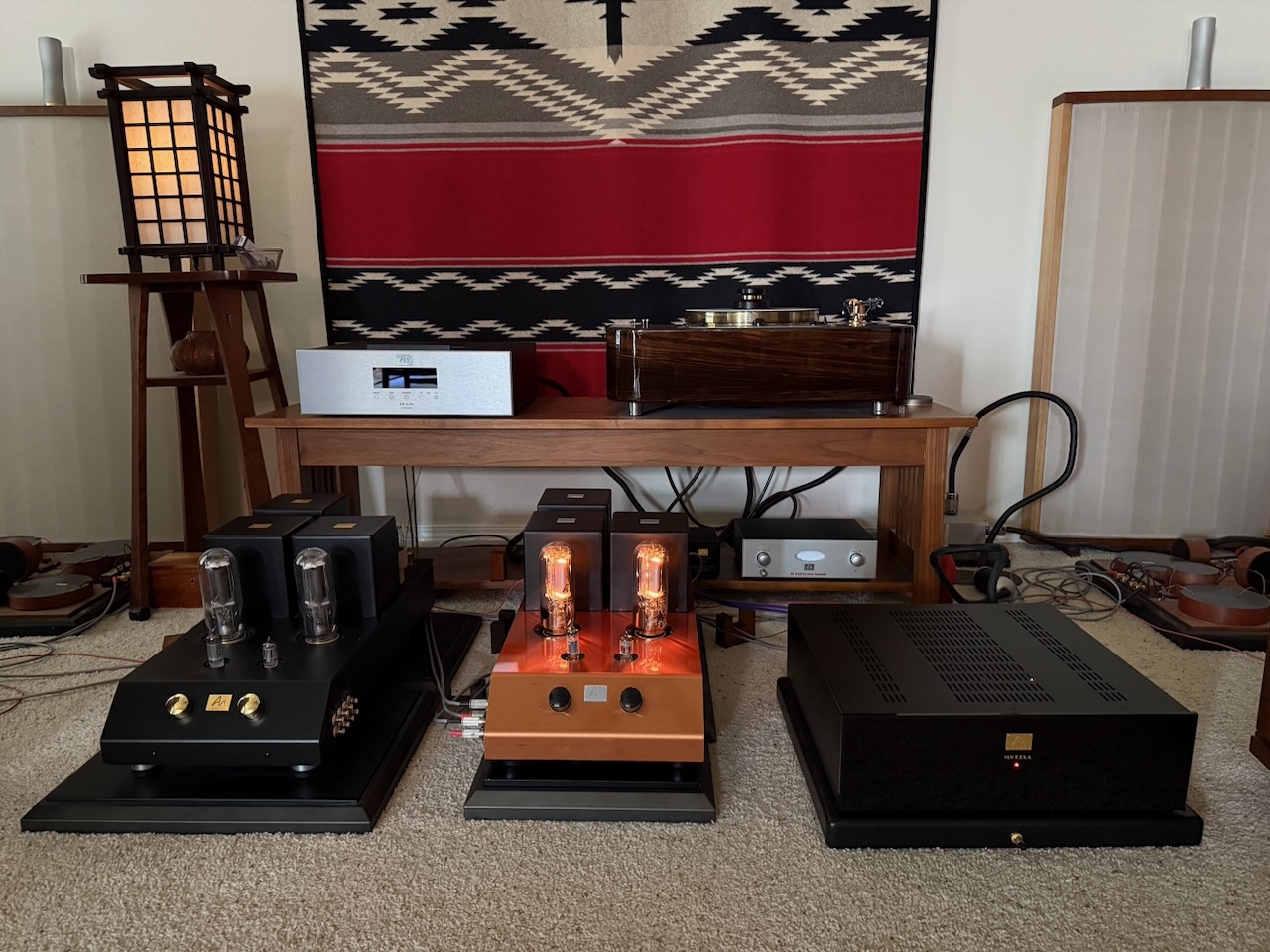
Audio Note (UK) AN-V silver interconnects and AN-SPe silver loudspeaker cables connect all the components together.
Acoustic Revive Absolute power cables connect the components to an Acoustic Revive RPT-6 Absolute NCF power distributor, which is connected to wall AC with an Acoustic Revive Absolute power cable.
The AC outlet consists of an Oyaide R-0 AC outlet, Acoustic Revive CB-1DB receptacle base plate, Acoustic Revive CFRP-1F carbon fiber outlet plate, and an Acoustic Revive CS-3K outlet stabilizer.
For cleaning records I use my homebrew cleaning solution with my VPI HW-19 vacuum record cleaning machine, followed by treatment with an Acoustic Revive RL-30 Mark III Analogue Disc Demagnetizer, both of which I highly recommend to vinyl aficionados.
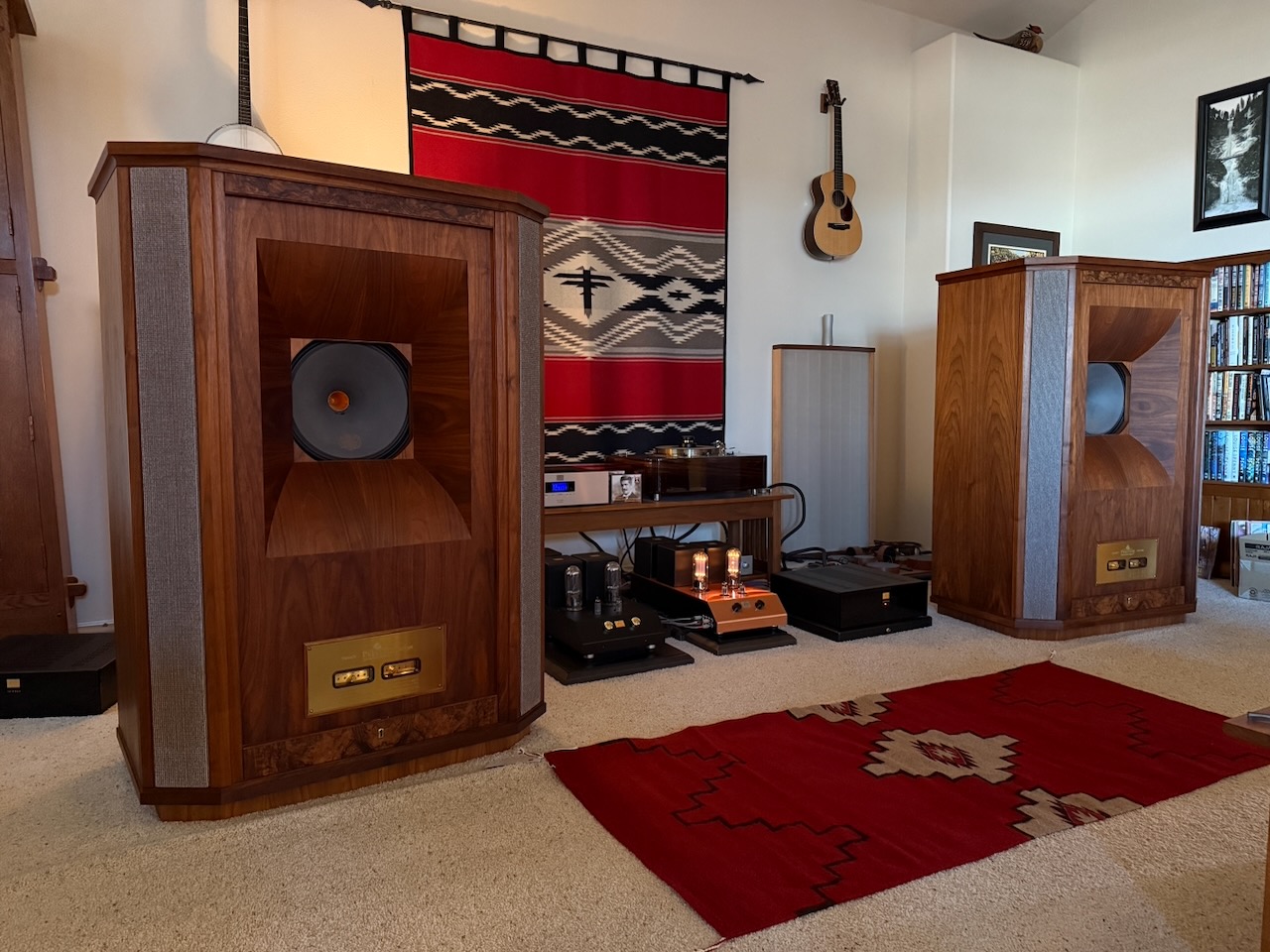
My room is equipped with three Acoustic Revive RWL-3 acoustic conditioners, one behind each loudspeaker, and one on the back wall. Two Acoustic Revive RHR-21 Helmholtz resonators are used for room tuning.
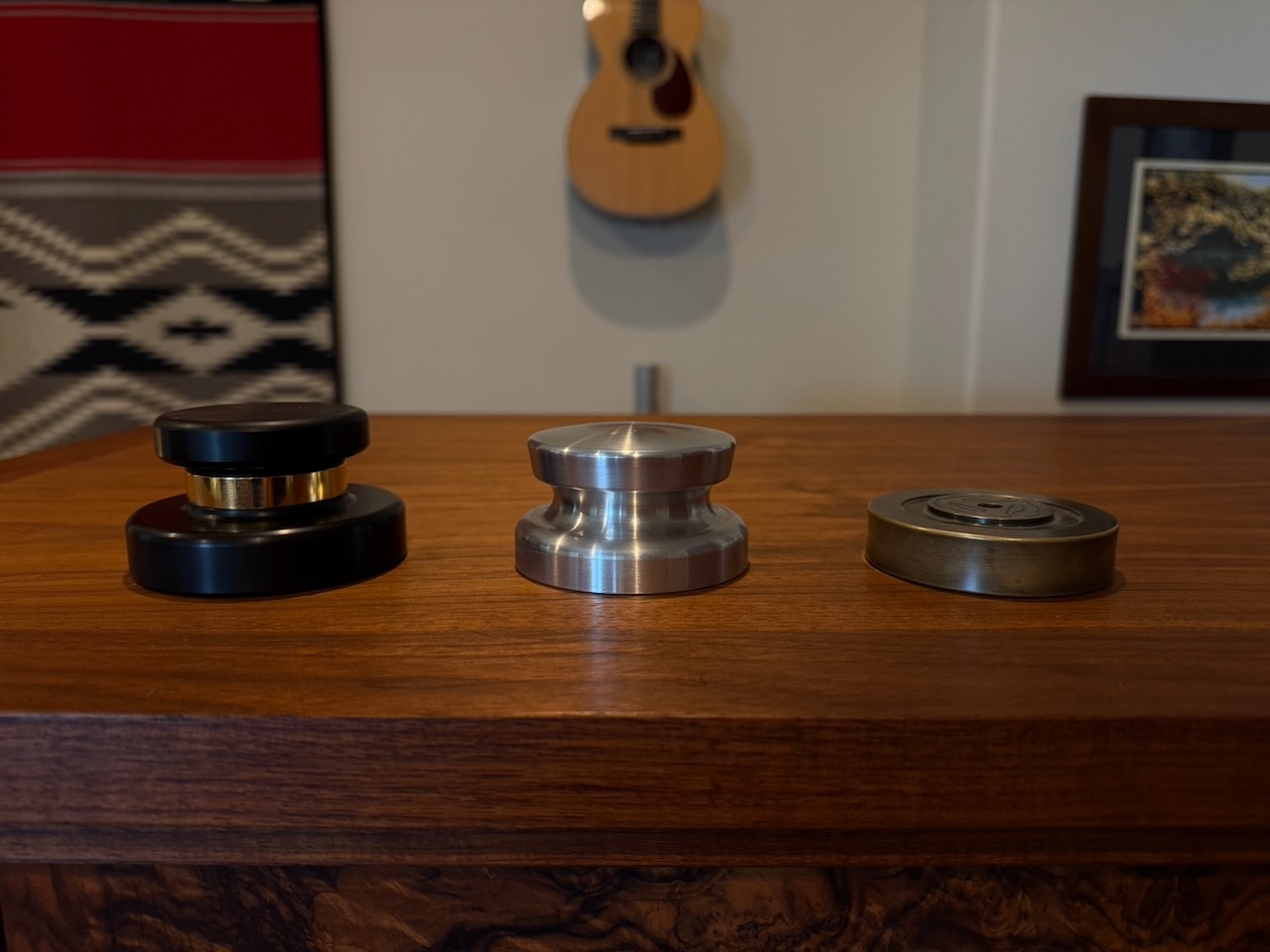
I used two other record weights I own as comparators to gather listening impressions: the 397 gram Artisan Fidelity CNC-milled 6061-T6 aluminum record weight ($249), and the 630 gram Fern & Roby brass record weight ($165).
Listening Impressions
That's it for now. Expect to see the full review published at Positive Feedback in the next week or so.
As always, thanks for stopping by, and may the tone be with you!